Packaged Solutions vs Tailor-Made HRMS Solutions
Navigate the critical decision between off-the-shelf and custom HRMS solutions. Compare costs, implementation, scalability, and features to find your perfect fit.
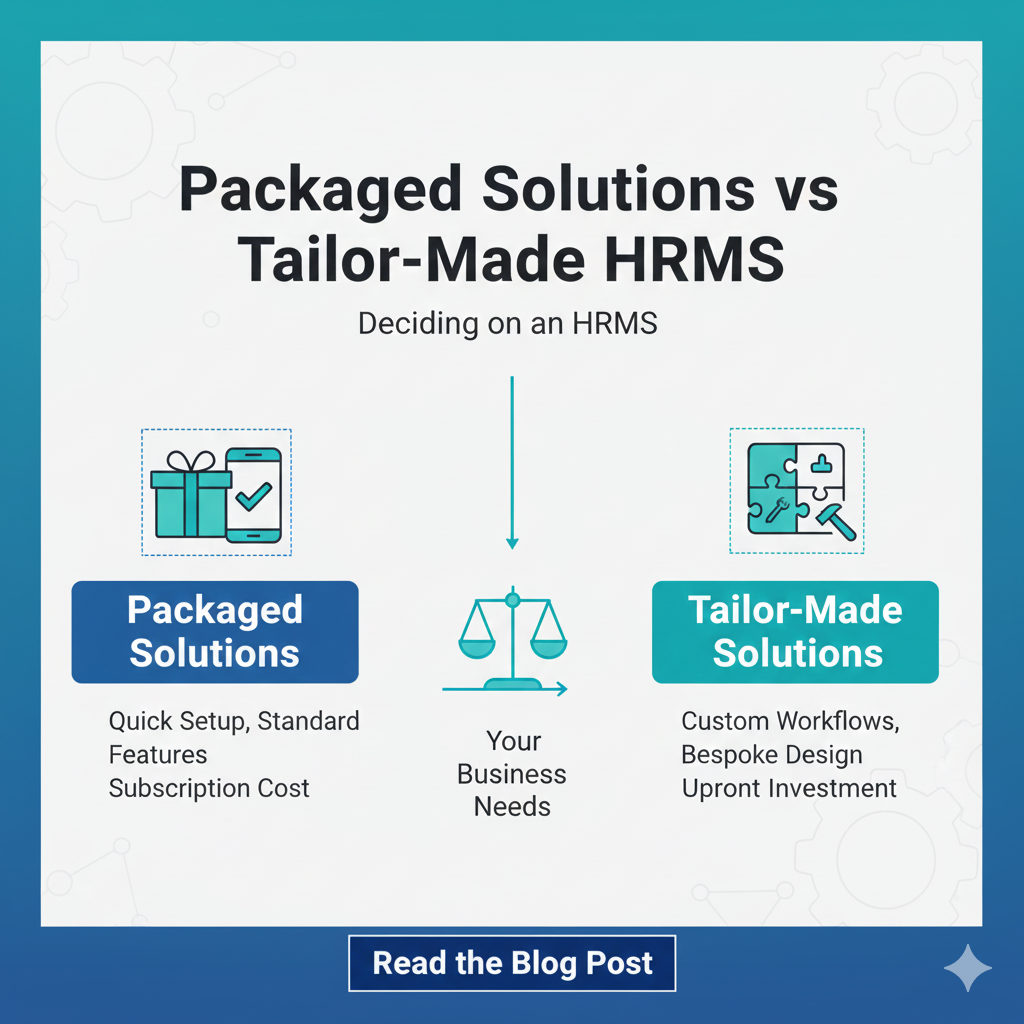
Choosing the right Human Resource Management System (HRMS) is one of the most crucial technology decisions your organization will make. An effective HRMS streamlines payroll, benefits administration, recruitment, performance management, and countless other HR functions that keep your business running smoothly.
With the abundance of HR technology options available today, the fundamental question most organizations face is: Should we implement a packaged (off-the-shelf) solution or invest in a tailor-made custom system?
This comprehensive guide examines both approaches, comparing costs, implementation timelines, scalability, flexibility, and maintenance requirements to help you make the most informed decision for your organization’s unique needs.
Understanding Packaged HRMS Solutions
A packaged HRMS solution is a ready-to-use software system designed to serve a broad range of organizations across various industries. These solutions come with pre-built features and functionalities that address common HR needs and processes.
Think of it like buying a car from a dealership – you choose from available models, each with predetermined features and specifications. While you might have some customization options (like color or trim level), the core functionality remains standardized.
Key Characteristics of Packaged Solutions:
- Industry-standard features: Built to serve common HR needs
- Quick deployment: Ready for implementation with minimal setup
- Subscription-based pricing: Typically SaaS (Software as a Service) model
- Vendor support: Maintenance and updates handled by the provider
- Proven reliability: Tested across numerous organizations
Exploring Tailor-Made HRMS Solutions
A tailor-made HRMS is a custom-built system designed specifically for your organization’s unique requirements, processes, and workflows. Every feature, interface, and functionality is developed to match your exact specifications.
Continuing the car analogy – this is like having a vehicle built from the ground up according to your precise requirements, with custom engine specifications, unique interior design, and specialized features that don’t exist in any standard model.
Key Characteristics of Custom Solutions:
- Unique functionality: Built specifically for your processes
- Complete flexibility: Every aspect can be customized
- Integration capabilities: Seamlessly connects with existing systems
- Ownership: You own the software and its source code
- Unlimited scalability: Can grow and evolve with your business
Comprehensive Comparison: Five Critical Factors
1. Cost and Investment Analysis
Packaged HRMS Solutions:
The financial structure of packaged solutions is straightforward and predictable. You’ll typically pay monthly or annual subscription fees based on the number of users or employees in your system. This creates predictable budgeting with no significant upfront development costs.
Advantages:
- Low initial investment
- Predictable monthly/annual costs
- No development expenses
- Shared infrastructure costs across all users
Considerations:
- Ongoing subscription fees can accumulate significantly over time
- Hidden costs may include additional modules, premium support, or user overages
- Price increases are controlled by the vendor
- Long-term costs may exceed custom development expenses
Tailor-Made HRMS Solutions:
Custom systems require substantial upfront investment for design, development, testing, and implementation. You’re paying for specialized expertise, custom coding, and extensive testing to ensure the system meets your exact requirements.
Advantages:
- One-time development cost creates a permanent asset
- No ongoing subscription fees after development
- Complete control over future development costs
- Potential for lower total cost of ownership over time
Considerations:
- High initial capital investment required
- Development costs can be unpredictable if scope changes
- Ongoing maintenance and support costs
- Requires budget allocation for future enhancements
2. Implementation Timeline
Packaged HRMS Solutions:
Speed is the primary advantage of off-the-shelf systems. Since the software already exists, implementation focuses on configuration, data migration, and user training. Most vendors can complete standard implementations within 4-12 weeks.
Implementation Process:
- System configuration and setup
- Data migration from existing systems
- User account creation and permissions
- Basic customization within available options
- User training and go-live support
Tailor-Made HRMS Solutions:
Custom development is inherently time-intensive, involving multiple phases from initial requirements gathering to final testing and deployment. The timeline can range from 6 months to 2+ years depending on complexity and scope.
Development Phases:
- Requirements analysis and system design
- Architecture planning and database design
- Custom development and coding
- Extensive testing and quality assurance
- User training and phased rollout
- Post-implementation support and refinement
3. Scalability and Future Growth
Packaged HRMS Solutions:
Modern SaaS platforms are built with scalability in mind, allowing easy addition of users as your company grows. Most vendors offer tiered pricing plans that provide access to additional features and capabilities.
Scalability Features:
- Easy user addition and removal
- Flexible pricing plans for growth
- Regular feature updates from vendor
- Proven scalability across customer base
Limitations:
- Constrained by vendor’s roadmap and capabilities
- May require system migration if growth exceeds platform limits
- Limited ability to add truly unique functionality
- Dependent on vendor’s infrastructure decisions
Tailor-Made HRMS Solutions:
Custom systems offer ultimate scalability because you control the architecture and infrastructure. The system can be designed to accommodate projected growth in users, data volume, and functionality.
Scalability Advantages:
- Architecture designed for your specific growth projections
- Unlimited customization potential
- Integration capabilities can expand as needed
- Performance optimization tailored to your usage patterns
Considerations:
- Requires accurate growth forecasting during design
- Scaling may require additional development investment
- Infrastructure management becomes your responsibility
- Technical expertise needed for ongoing scalability planning
4. Features and Flexibility
Packaged HRMS Solutions:
Off-the-shelf systems provide comprehensive feature sets based on industry best practices and common requirements. These features are thoroughly tested and proven across numerous organizations.
Standard Features Typically Include:
- Employee database management
- Payroll processing and tax calculations
- Benefits administration
- Time and attendance tracking
- Performance management tools
- Reporting and analytics dashboards
Flexibility Limitations:
- Limited customization options
- Workflows must adapt to software constraints
- Integration capabilities restricted to supported systems
- Feature development dependent on vendor roadmap
Tailor-Made HRMS Solutions:
Custom systems offer unlimited flexibility to create exactly the functionality your organization needs. Every workflow, report, and user interface can be designed to match your specific requirements.
Customization Possibilities:
- Unique workflows matching your processes
- Custom reporting tailored to your metrics
- Specialized integrations with legacy systems
- User interfaces designed for your team’s preferences
- Industry-specific compliance and regulatory features
Considerations:
- Requires clear understanding of requirements upfront
- Changes after development can be expensive
- Feature complexity may impact system performance
- Ongoing maintenance responsibility for custom features
5. Maintenance and Support
Packaged HRMS Solutions:
Vendor-managed maintenance is a significant advantage of SaaS solutions. The provider handles all system updates, security patches, infrastructure management, and technical support.
Vendor Responsibilities:
- Regular software updates and feature releases
- Security monitoring and patch management
- Infrastructure maintenance and scaling
- Technical support and troubleshooting
- Regulatory compliance updates
- Data backup and disaster recovery
Support Limitations:
- Support quality varies by vendor and plan level
- Limited customization in support processes
- Dependency on vendor’s technical capabilities
- Potential for service disruptions outside your control
Tailor-Made HRMS Solutions:
Custom systems require dedicated maintenance resources, whether internal IT staff or external development partners. While this increases operational responsibility, it provides complete control over maintenance priorities and schedules.
Maintenance Requirements:
- Bug fixes and system troubleshooting
- Security updates and vulnerability patches
- Performance optimization and monitoring
- Integration maintenance as systems evolve
- User support and training programs
- Infrastructure management and scaling
Control Advantages:
- Maintenance schedules align with your priorities
- Direct access to system architecture and code
- Custom support processes tailored to your needs
- Independence from vendor business decisions
Making the Right Choice: Decision Framework
Choose a Packaged HRMS Solution When:
Organizational Characteristics:
- Small to medium-sized business (under 500 employees)
- Standard HR processes that align with industry practices
- Limited internal IT resources or technical expertise
- Need for rapid implementation and immediate benefits
Financial Considerations:
- Limited budget for large upfront investments
- Preference for predictable monthly operational expenses
- Want to avoid risks associated with custom development projects
Operational Preferences:
- Prefer vendor-managed maintenance and support
- Comfortable adapting processes to software capabilities
- Value proven, tested functionality over unique features
Invest in a Tailor-Made HRMS Solution When:
Organizational Characteristics:
- Large enterprise with complex, unique HR processes
- Highly regulated industry with specific compliance requirements
- Significant investment in legacy systems requiring integration
- Strong internal IT capabilities or development partnerships
Strategic Requirements:
- Long-term vision requiring flexible, evolving system capabilities
- Competitive advantage dependent on unique HR processes
- Need for extensive customization beyond standard features
- Multiple subsidiary companies with varying requirements
Financial Capacity:
- Sufficient budget for substantial upfront investment
- Resources allocated for ongoing maintenance and development
- Long-term perspective on technology return on investment
Implementation Best Practices
For Packaged Solutions:
- Thorough Vendor Evaluation: Research multiple providers, compare features, and check references
- Pilot Testing: Conduct proof-of-concept implementations with key stakeholders
- Change Management: Prepare your team for process adaptations required by the software
- Data Migration Planning: Ensure clean, accurate data transfer from legacy systems
- Training Investment: Allocate sufficient time and resources for user adoption
For Custom Solutions:
- Detailed Requirements Analysis: Invest heavily in understanding and documenting exact needs
- Experienced Development Team: Partner with proven developers specializing in HR systems
- Phased Implementation: Consider modular development to reduce risk and provide early wins
- Extensive Testing: Plan for comprehensive testing including user acceptance and performance
- Ongoing Support Strategy: Establish maintenance and support processes before go-live
Future-Proofing Your HRMS Decision
Technology Trends to Consider:
Artificial Intelligence and Machine Learning:
- Packaged solutions increasingly integrate AI for predictive analytics
- Custom systems can incorporate cutting-edge AI tailored to your specific needs
Mobile-First Design:
- Modern packaged solutions prioritize mobile functionality
- Custom development can create unique mobile experiences
Integration Capabilities:
- Cloud-based packaged solutions offer extensive API connectivity
- Custom systems provide unlimited integration possibilities
Data Analytics and Reporting:
- Standard solutions include comprehensive reporting dashboards
- Custom systems enable unique analytics tailored to your KPIs
Conclusion: Strategic Alignment is Key
The choice between packaged and tailor-made HRMS solutions isn’t about finding the “better” option – it’s about identifying the approach that best aligns with your organization’s specific needs, resources, and strategic objectives.
Packaged solutions excel for organizations seeking rapid implementation, predictable costs, and proven functionality. They’re ideal when your HR processes align reasonably well with industry standards and you prefer to focus internal resources on core business activities rather than technology management.
Tailor-made solutions are optimal when your competitive advantage depends on unique HR processes, when you have complex integration requirements, or when standard software cannot accommodate your specific needs. They require significant investment but provide unlimited flexibility and complete control.
Consider these final questions as you make your decision:
- How unique are your HR processes compared to industry standards?
- What’s your tolerance for adapting processes to fit software constraints?
- Do you have the technical resources to support a custom system?
- What’s your long-term vision for HR technology in your organization?
- How critical is HR system functionality to your competitive advantage?
Remember that this decision will impact your organization for years to come. Take the time to thoroughly evaluate both options, involve key stakeholders in the decision-making process, and choose the solution that best positions your HR team to support your organization’s growth and success.
Whether you choose a packaged solution or invest in custom development, the most important outcome is selecting an HRMS that empowers your HR team to focus on strategic initiatives that drive organizational excellence and employee satisfaction.