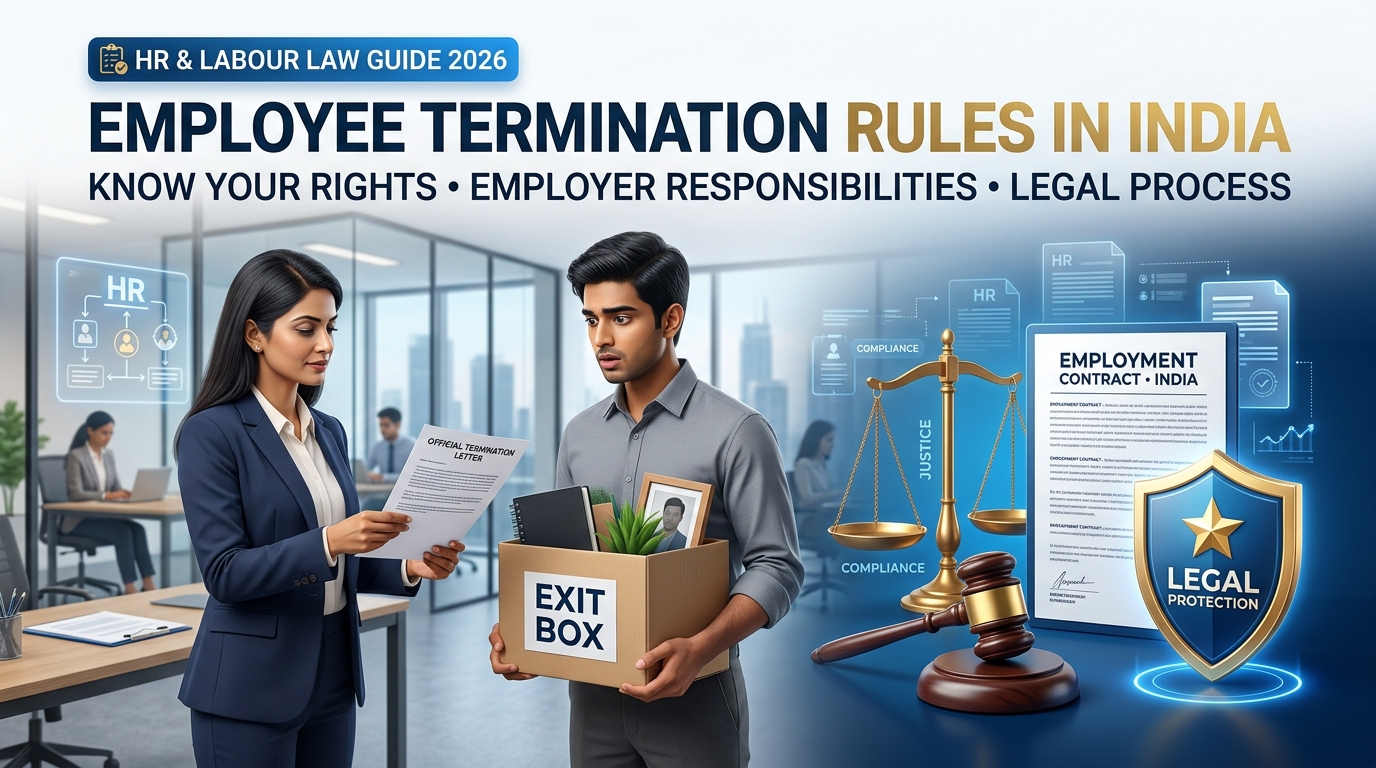
Employee Termination Rules in India: A Practical Guide for Employers and Employees
Learn about employee termination laws in India, including notice periods, retrenchment compensation, misconduct dismissals, factory worker protections, and maternity-related safeguards.
Employee Termination Rules in India: A Practical Guide for Employers and Employees
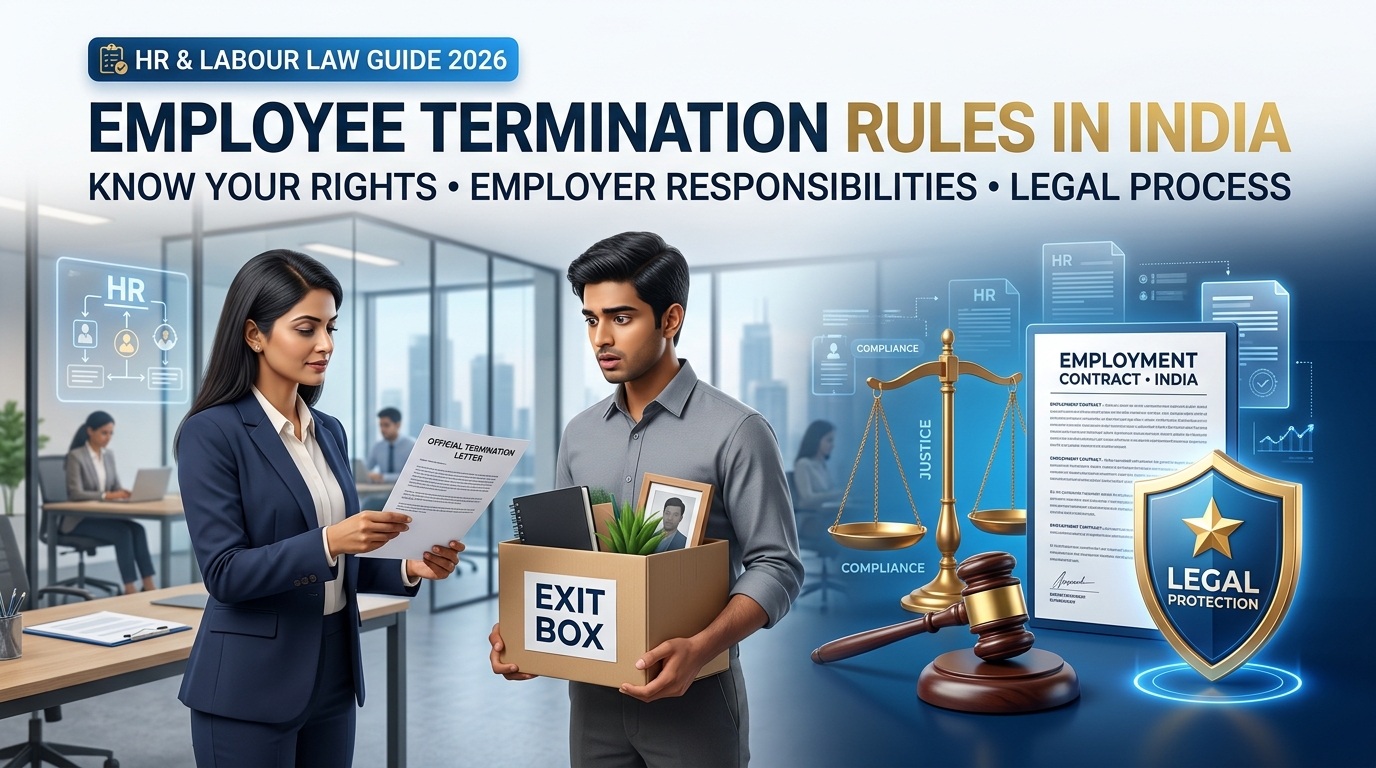
Employee termination is one of the most sensitive aspects of employment law in India. Whether an employer is ending employment due to poor performance, misconduct, redundancy, business restructuring, contract expiry, or organizational closure, the process must be handled carefully and lawfully.
Termination directly affects an employee’s livelihood, career stability, and legal rights. At the same time, improper termination can expose employers to labor disputes, compensation claims, reinstatement orders, legal penalties, and reputational risks.
This guide explains employee termination rules in India, employer obligations, employee rights, retrenchment regulations, factory worker protections, and special safeguards available under Indian labor laws.
Disclaimer: This article is for informational purposes only and does not constitute legal advice. Employment obligations may vary depending on the appointment letter, industry, state-specific regulations, and applicable labor laws.
Understanding Employee Termination in India
Employee termination refers to the formal end of the employer-employee relationship. However, not all employment exits are legally treated the same way.
Common types of employment separation include:
- Employee resignation
- Mutual separation agreements
- Termination during probation
- Termination due to poor performance
- Dismissal for misconduct
- Retrenchment due to redundancy
- Business closure
- Expiry or non-renewal of a fixed-term contract
- Retirement or superannuation
The legal requirements depend largely on the reason for termination, the employee’s role, and the applicable labor laws.
Legal Framework Governing Termination
Employee termination in India is governed by several legal and contractual provisions, including:
- Employment contracts and appointment letters
- Company HR policies
- The Industrial Relations Code, 2020
- State-specific labor regulations
- Standing Orders, where applicable
- Social security and wage laws
Employers must ensure that contractual provisions do not violate statutory labor protections.
How an Employee Can Be Terminated in India
An employer must have a valid reason and follow a fair process before terminating employment.
Most appointment letters contain clauses related to:
- Notice periods
- Salary in lieu of notice
- Probation conditions
- Performance expectations
- Misconduct provisions
- Confidentiality obligations
- Handover requirements
- Grounds for termination
However, contractual clauses cannot override employee rights guaranteed under labor laws.
Recommended Termination Process
A legally compliant termination process typically includes:
- Reviewing the employment contract and company policies.
- Identifying the reason for termination.
- Determining whether labor law protections apply.
- Maintaining documentation supporting the decision.
- Issuing warnings where appropriate.
- Conducting disciplinary proceedings in misconduct cases.
- Calculating final dues and statutory benefits.
- Providing a written termination letter.
Employers should document every step carefully to reduce legal risks.
Termination Due to Poor Performance
Poor performance is one of the most common reasons for termination.
However, employers should provide employees with a reasonable opportunity to improve before ending employment.
A fair performance management process generally includes:
- Performance feedback
- Written warnings
- Performance Improvement Plans (PIPs)
- Coaching or mentoring
- Clearly defined expectations
- Review meetings
- A documented improvement timeline
Termination should never be disguised as redundancy when the actual reason is performance-related or personal conflict.
Dismissal for Misconduct
Misconduct-related termination differs significantly from retrenchment.
Examples of serious misconduct may include:
- Fraud
- Theft
- Harassment
- Workplace violence
- Data theft or unauthorized disclosure
- Severe insubordination
- Record manipulation
- Habitual absenteeism
In serious cases, employees may be suspended during investigations.
Fair Disciplinary Process
Before dismissal, employers should generally conduct a fair inquiry process that includes:
- A written charge sheet or notice
- Adequate time for the employee to respond
- An internal investigation
- Access to relevant evidence
- An opportunity to present a defense
- A reasoned final decision
Labor authorities and tribunals may review whether due process was followed and may order reinstatement or compensation where dismissals are found to be unjustified.
Retrenchment Rules in India
Retrenchment refers to termination initiated by the employer for business-related reasons rather than employee misconduct.
Common retrenchment situations include:
- Business restructuring
- Automation
- Cost reduction initiatives
- Workforce downsizing
- Redundancy of positions
- Reduced workload
What Is Not Considered Retrenchment?
Under the Industrial Relations Code, retrenchment generally does not include:
- Voluntary retirement
- Retirement on reaching retirement age
- Contract expiry
- Non-renewal of fixed-term contracts
- Termination due to continued ill-health
Conditions for Retrenchment
Employees who have completed at least one year of continuous service are entitled to certain protections before retrenchment.
Employers must generally provide:
Notice Requirement
- One month’s written notice stating the reasons for retrenchment, or
- Wages in lieu of notice
Retrenchment Compensation
Compensation must generally be at least:
15 days’ average pay for every completed year of continuous service, including service exceeding six months in the final year.
Government Notification
Employers may also be required to notify the appropriate government authority as prescribed by law.
Simply paying one month’s salary does not automatically satisfy retrenchment requirements.
Last-In, First-Out Principle
The Industrial Relations Code generally follows the Last In, First Out (LIFO) principle during retrenchment.
This means:
- Employees most recently hired within a category are usually retrenched first.
- Employers must document valid reasons if they choose a different order.
If the organization hires again within one year, preference should generally be given to retrenched employees.
Government Approval for Large Establishments
Certain larger industrial establishments face additional compliance requirements.
Organizations employing more than 300 workers may require prior government approval before retrenching eligible workers.
Additional Requirements
Covered establishments may need to:
- Provide three months’ notice or wages in lieu thereof
- Clearly state retrenchment reasons
- Apply for government approval
- Share copies with affected workers
Retrenchment conducted without required approval may be considered unlawful.
Worker Re-Skilling Fund
The Industrial Relations Code introduced provisions for a Worker Re-Skilling Fund.
In qualifying retrenchment cases, employers may be required to contribute an amount equal to:
15 days of the worker’s last drawn wages
The amount is intended to support the worker’s transition and skill development after separation.
Factory Workers and Termination Rules
Historically, the Factories Act focused primarily on:
- Workplace safety
- Health standards
- Working conditions
Termination and retrenchment matters are generally governed by labor relations laws rather than factory safety laws.
Protections for Factory Workers
Factory workers may receive termination-related protections through:
- The Industrial Relations Code, 2020
- Standing Orders
- Employment contracts
- Wage laws
- Social security laws
- State labor regulations
- Industrial dispute procedures
Checklist Before Firing an Employee in India
Before proceeding with termination, employers should evaluate:
- Is the notice period defined in the appointment letter?
- Is the employee on probation?
- Have written warnings been issued?
- Is there documented misconduct?
- Has a disciplinary process been completed?
- Does labor law classify the individual as a worker?
- Is retrenchment compensation required?
- Have all procedural requirements been followed?
Careful evaluation helps reduce legal and compliance risks.
Termination Rules for Pregnant Employees in India
Pregnancy-related termination protections are among the most important safeguards under Indian employment law.
Employers cannot terminate an employee simply because she is pregnant or on maternity leave.
Key Protections
- Employers cannot dismiss employees due to pregnancy.
- Employees cannot be terminated because they are on approved maternity leave.
- Employers cannot serve notices that expire during protected maternity leave periods.
- Maternity benefits cannot generally be denied because of pregnancy-related absence.
Exception for Gross Misconduct
In limited cases involving proven gross misconduct, disciplinary action may be taken. However, employers must follow proper procedures and document the reasons carefully.
Right to Appeal
Employees who believe they have been unfairly terminated during pregnancy or denied maternity benefits may seek legal remedies through the appropriate authorities.
What Employees Should Do After Receiving a Termination Letter
Important records to preserve include:
- Appointment letter
- Employment contract
- Termination letter
- Salary slips
- Performance reviews
- Warning letters
- Email communications
- Notice period details
- Full and final settlement calculations
- Leave records
- Gratuity documentation
- Provident Fund records
- Insurance-related documents
If the termination appears unlawful, discriminatory, retaliatory, or procedurally unfair, employees may seek assistance through:
- Internal grievance mechanisms
- Labor authorities
- Conciliation proceedings
- Legal counsel
Final Thoughts
Employee termination is far more than an administrative HR activity. It is a legally regulated process that requires fairness, transparency, documentation, and compliance with labor laws.
Employers should avoid:
- Verbal dismissals
- Abrupt terminations
- Undocumented allegations
- Discriminatory actions
- Retaliatory behavior
Employees should understand their contractual rights, preserve records, and seek guidance whenever they believe their rights have been violated.
Whether the situation involves poor performance, misconduct, retrenchment, factory workforce reductions, maternity protections, or contract completion, following the correct process protects both the organization and the employee.
Frequently Asked Questions
Can an employer terminate an employee without notice in India?
Generally, employers must comply with the notice period specified in the employment contract or applicable labor laws unless the termination is due to proven gross misconduct.
What compensation is payable during retrenchment?
Eligible employees are generally entitled to compensation equal to 15 days’ average pay for every completed year of continuous service.
Can a pregnant employee be terminated in India?
An employer cannot terminate an employee merely because she is pregnant or on maternity leave. Additional legal protections apply under maternity benefit laws.
What is the Last In, First Out principle?
During retrenchment, employees who were hired most recently are generally terminated first unless the employer has valid reasons to follow a different approach.
What should an employee do after receiving a termination letter?
Employees should preserve all employment records, verify final settlements and statutory dues, and seek legal or professional advice if the termination appears unfair or unlawful.
Similar blogs you may like