Assessment Year vs Financial Year: Meaning, Examples & Current AY in India
Understand the difference between Assessment Year and Financial Year in India with examples. Learn the current assessment year, current financial year, and how they affect income tax return filing.
Introduction
Most taxpayers filing income tax returns often confuse Financial Year (FY) and Assessment Year (AY). While the distinction may seem small, selecting the wrong year can lead to filing errors, tax mismatches, and compliance issues.
The difference is straightforward:
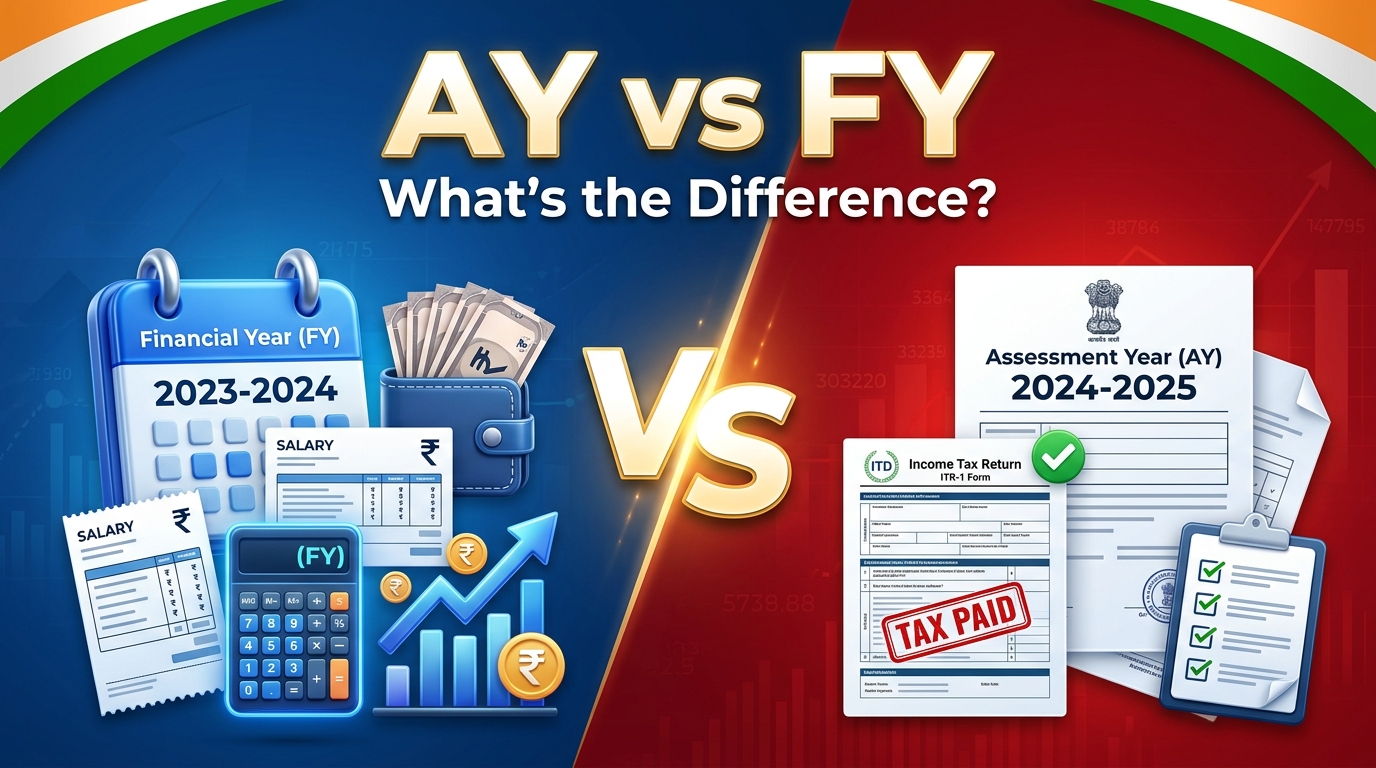
- Financial Year (FY) is the year in which income is earned.
- Assessment Year (AY) is the year in which that income is assessed and taxed.
Understanding this distinction is essential for salaried employees, freelancers, business owners, and companies to ensure accurate tax filing and financial planning.
What Is a Financial Year?
A Financial Year (FY) is the 12-month period during which income is earned.
In India, the financial year runs from 1 April to 31 March of the following calendar year.
For example:
Income earned between 1 April 2025 and 31 March 2026 belongs to FY 2025-26.
Financial Year = Year in Which Income Is Earned
Examples of income earned during a financial year include:
- Salary income
- Business income
- Professional or freelance income
- Rental income
- Interest income
- Dividend income
- Capital gains
- Other taxable income
The financial year is the period during which all income, expenses, investments, and tax-saving activities take place.
What Is an Assessment Year?
The Assessment Year (AY) is the year immediately following the financial year.
During this period, income earned in the previous financial year is reported, assessed, and taxed through the income tax return process.
For example:
- Income earned in FY 2025-26
- Will be assessed in AY 2026-27
Assessment Year = Year in Which Income Is Assessed and Return Is Filed
Taxpayers file their returns only after the financial year ends because complete information regarding income, deductions, TDS, exemptions, and tax liability becomes available only after the financial year closes.
Assessment Year vs Financial Year
The primary difference lies in timing.
| Basis | Financial Year (FY) | Assessment Year (AY) |
|---|---|---|
| Meaning | Year in which income is earned | Year in which income is assessed and taxed |
| Also Known As | FY | AY |
| Occurs | Before Assessment Year | After Financial Year |
| Purpose | Earning and recording income | Return filing and tax assessment |
| Example | FY 2025-26 | AY 2026-27 |
| Period | 1 Apr 2025 – 31 Mar 2026 | 1 Apr 2026 – 31 Mar 2027 |
Easy Formula
FY comes first. AY comes next.
Example of Financial Year and Assessment Year
Suppose you earn income between:
1 April 2025 and 31 March 2026
Then:
- Financial Year = FY 2025-26
- Assessment Year = AY 2026-27
This means the income earned during FY 2025-26 will be reported and assessed during AY 2026-27.
FY and AY Mapping Table
| Income Earned During | Financial Year | Assessment Year |
|---|---|---|
| 1 Apr 2023 – 31 Mar 2024 | FY 2023-24 | AY 2024-25 |
| 1 Apr 2024 – 31 Mar 2025 | FY 2024-25 | AY 2025-26 |
| 1 Apr 2025 – 31 Mar 2026 | FY 2025-26 | AY 2026-27 |
| 1 Apr 2026 – 31 Mar 2027 | FY 2026-27 | AY 2027-28 |
What Is the Current Assessment Year?
For income tax return filing purposes in 2026:
Current Assessment Year
AY 2026-27
This assessment year applies to income earned during:
FY 2025-26
If you’re filing a return for income earned from 1 April 2025 to 31 March 2026, you should select:
Assessment Year 2026-27
In Which Assessment Year Is Income Tax Levied?
Income tax is levied during the assessment year.
For income earned during:
FY 2025-26
The applicable assessment year is:
AY 2026-27
This includes:
- Salary income
- Business income
- Professional income
- Rental income
- Interest income
- Capital gains
- Other taxable income
This is why documents such as Form 16, TDS certificates, and ITR forms refer to the assessment year.
What Is the Current Financial Year in India?
The current financial year is:
FY 2026-27
Period: 1 April 2026 to 31 March 2027
Income earned during FY 2026-27 will be assessed in:
AY 2027-28
Current Financial Year and Assessment Year Explained
There are two ways people usually ask this question.
For Ongoing Income
- Current Financial Year: FY 2026-27
- Corresponding Assessment Year: AY 2027-28
For Income Tax Return Filing in 2026
- Assessment Year: AY 2026-27
- Financial Year: FY 2025-26
The phrase current assessment year usually refers to the year for which income tax returns are currently being filed.
Why Does Assessment Year Come After Financial Year?
Income must first be earned before it can be assessed.
Only after the financial year ends can taxpayers calculate:
- Total income
- Deductions
- TDS credits
- Advance tax
- Refunds
- Tax liability
Therefore, assessment always happens in the following year.
Importance of Assessment Year While Filing ITR
Selecting the correct assessment year is one of the most important parts of filing an income tax return.
Choosing the wrong AY can result in:
- Incorrect filing
- Data mismatches
- Processing delays
- Notices from the Income Tax Department
Assessment Year is referenced in:
- ITR filing
- Form 16
- Form 26AS
- Annual Information Statement (AIS)
- TDS certificates
- Tax payments
- Refund tracking
- Income tax notices
- Challans
Importance of Financial Year in Tax Planning
The financial year is important because it is the period during which income is earned and investments are made.
Tax-saving deductions such as:
- Section 80C
- Section 80D
- Section 80G
- Home loan interest deductions
must relate to the relevant financial year.
Businesses also use the financial year to track:
- Revenue
- Expenses
- Profit
- Payroll
- Vendor payments
- Tax deductions
- Accounting records
- Audits
- GST compliance
- Income tax compliance
Common Mistakes Taxpayers Make
Selecting the Wrong Assessment Year
Many taxpayers mistakenly choose the financial year instead of the assessment year.
Confusing Calendar Year with Financial Year
India follows the financial year from 1 April to 31 March, not the calendar year.
Filing Without Verifying Total Income
Before filing returns, taxpayers should verify:
- Form 16
- Interest income
- Capital gains
- Rental income
- Other sources of income
Ignoring Form 26AS and AIS
Income details should match:
- Form 26AS
- Annual Information Statement (AIS)
- TDS certificates
Not Understanding Previous Year
Under the Income Tax Act:
Previous Year = Financial Year immediately preceding the Assessment Year
AY vs FY Formula
The easiest way to remember:
Assessment Year = Financial Year + 1 Year
| Financial Year | Assessment Year |
|---|---|
| FY 2024-25 | AY 2025-26 |
| FY 2025-26 | AY 2026-27 |
| FY 2026-27 | AY 2027-28 |
Difference Between AY and FY for Salaried Employees
For salaried employees:
- Salary is earned during the Financial Year.
- TDS is deducted throughout the Financial Year.
- Form 16 is issued after the Financial Year ends.
- Income tax returns are filed during the Assessment Year.
Difference Between AY and FY for Businesses
Businesses use the financial year to record:
- Revenue
- Expenses
- Payroll
- GST transactions
- Accounting records
After the financial year ends, businesses:
- Prepare financial statements
- Calculate taxable income
- Verify deductions
- File income tax returns
How ZestNexus Helps Businesses Stay Organized
Managing payroll, attendance, reimbursements, employee records, and compliance through spreadsheets often creates year-end challenges.
ZestNexus helps businesses organize:
- Employee records
- Salary information
- Attendance data
- Leave records
- Payroll inputs
- Reimbursement details
- Compliance documents
- Reporting data
With organized workforce records, businesses can simplify payroll management and prepare for tax filing with greater accuracy.
Conclusion
The difference between Assessment Year and Financial Year is simple but extremely important.
- Financial Year is the year in which income is earned.
- Assessment Year is the following year in which that income is assessed and taxed.
Quick Recap
| Income Earned In | Assessed In |
|---|---|
| FY 2025-26 | AY 2026-27 |
| FY 2026-27 | AY 2027-28 |
Understanding this distinction helps taxpayers file returns correctly, avoid errors, and maintain better financial records.
Businesses can further simplify payroll, reporting, and compliance management by maintaining structured employee and financial data using ZestNexus.
Frequently Asked Questions
What is the difference between Financial Year and Assessment Year?
The Financial Year is the year in which income is earned, while the Assessment Year is the following year in which that income is assessed and taxed.
What is the current assessment year?
For income tax return filing in 2026, the current assessment year is AY 2026-27.
What is the current financial year in India?
The current financial year is FY 2026-27, covering the period from 1 April 2026 to 31 March 2027.
What is the assessment year for FY 2025-26?
The corresponding assessment year for FY 2025-26 is AY 2026-27.
Why does the assessment year come after the financial year?
Income must first be earned during the Financial Year. Only after the year ends can taxpayers calculate their total income, claim deductions, and file returns during the Assessment Year.
Similar blogs you may like