What Is Leave Without Pay (LOP)? Calculation, Rules & Management in HRMS (2026 Guide)
Learn what Leave Without Pay (LOP) or Loss of Pay means, when it applies, how it is calculated, its impact on payroll, and how HRMS software simplifies LOP management.
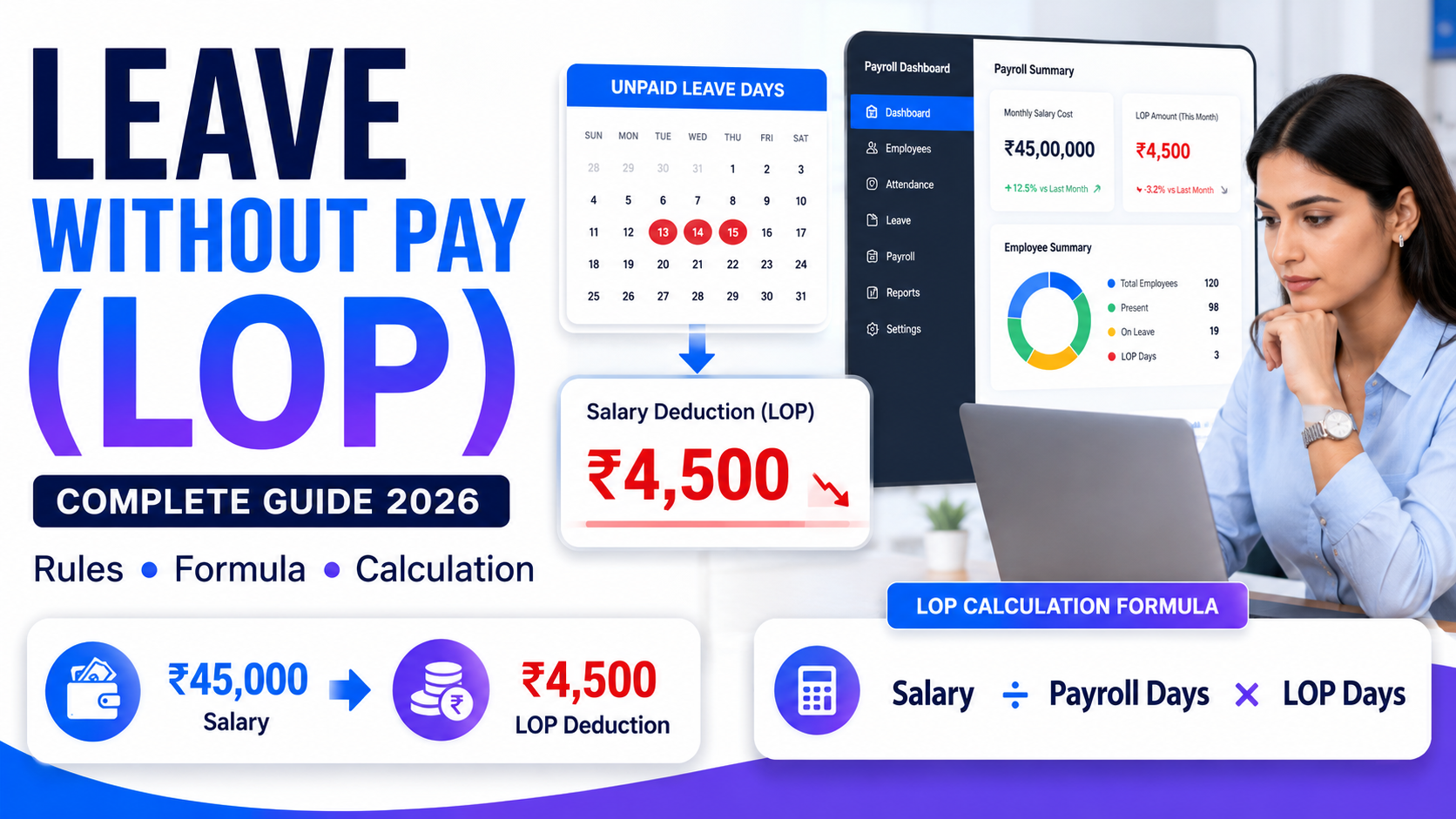
Tracking attendance and leave is a critical function for every organization as part of its HR and payroll processes. However, there are situations where an employee takes leave after exhausting their available paid leave balance. In such cases, the absence may be treated as Loss of Pay (LOP) or Leave Without Pay (LWP).
LOP directly affects an employee’s salary and is an important part of payroll processing, leave management, and compliance.
In this guide, you’ll learn:
- What Loss of Pay (LOP) means
- When LOP applies
- How LOP is calculated
- How it affects payroll
- Best practices for HR teams
- How ZestNexus HRMS simplifies LOP management
What Is Loss of Pay (LOP)?
Loss of Pay (LOP) refers to unpaid leave taken by an employee when they have exhausted their available paid leave or when the leave taken is not eligible for paid compensation.
In such situations, the employee may remain absent from work with the employer’s approval, but the salary corresponding to those unpaid leave days is deducted from their monthly salary.
LOP is also commonly referred to as:
- Leave Without Pay (LWP)
- Unpaid Leave
- Salary Deduction Leave
LOP policies are generally defined in an organization’s leave policy, employment contract, or employee handbook.
When Does Loss of Pay Apply?
There are several situations where Loss of Pay may apply.
1. Insufficient Leave Balance
Employees who have exhausted their available paid leave, such as:
- Earned Leave (EL)
- Casual Leave (CL)
- Sick Leave (SL)
may have additional leave treated as LOP according to company policy.
2. Unauthorized Absence
If an employee is absent without prior approval or a valid explanation, the organization may mark those days as Loss of Pay.
3. Leave Beyond Approved Limits
If an employee exceeds their approved leave entitlement, the additional leave may become unpaid.
For example:
- Paid Leave Available: 2 Days
- Leave Taken: 5 Days
- LOP Days: 3 Days
4. Leave Without Pay Requests
Employees may request unpaid leave for reasons such as:
- Personal commitments
- Higher education
- Family responsibilities
- Extended travel
If approved, the leave is recorded as LOP.
5. Absence During Mandatory Working Days
Organizations sometimes designate mandatory working days after adjusting holidays.
Unauthorized absence on these days may be treated as Loss of Pay.
6. Non-Compliance with Attendance Policies
Repeated late arrivals, missed attendance punches, or attendance policy violations may result in salary deductions where permitted by company policy.
Paid Leave vs Loss of Pay
| Paid Leave | Loss of Pay (LOP) |
|---|---|
| Employee receives salary during leave | Salary is deducted for unpaid leave |
| Leave is adjusted against available leave balance | No paid leave balance is available or leave is unpaid |
| Does not usually reduce monthly salary | Reduces monthly salary |
| Governed by leave entitlement | Governed by leave and payroll policies |
How Is Loss of Pay Calculated?
The Loss of Pay deduction is generally based on the employee’s daily salary and the number of unpaid leave days.
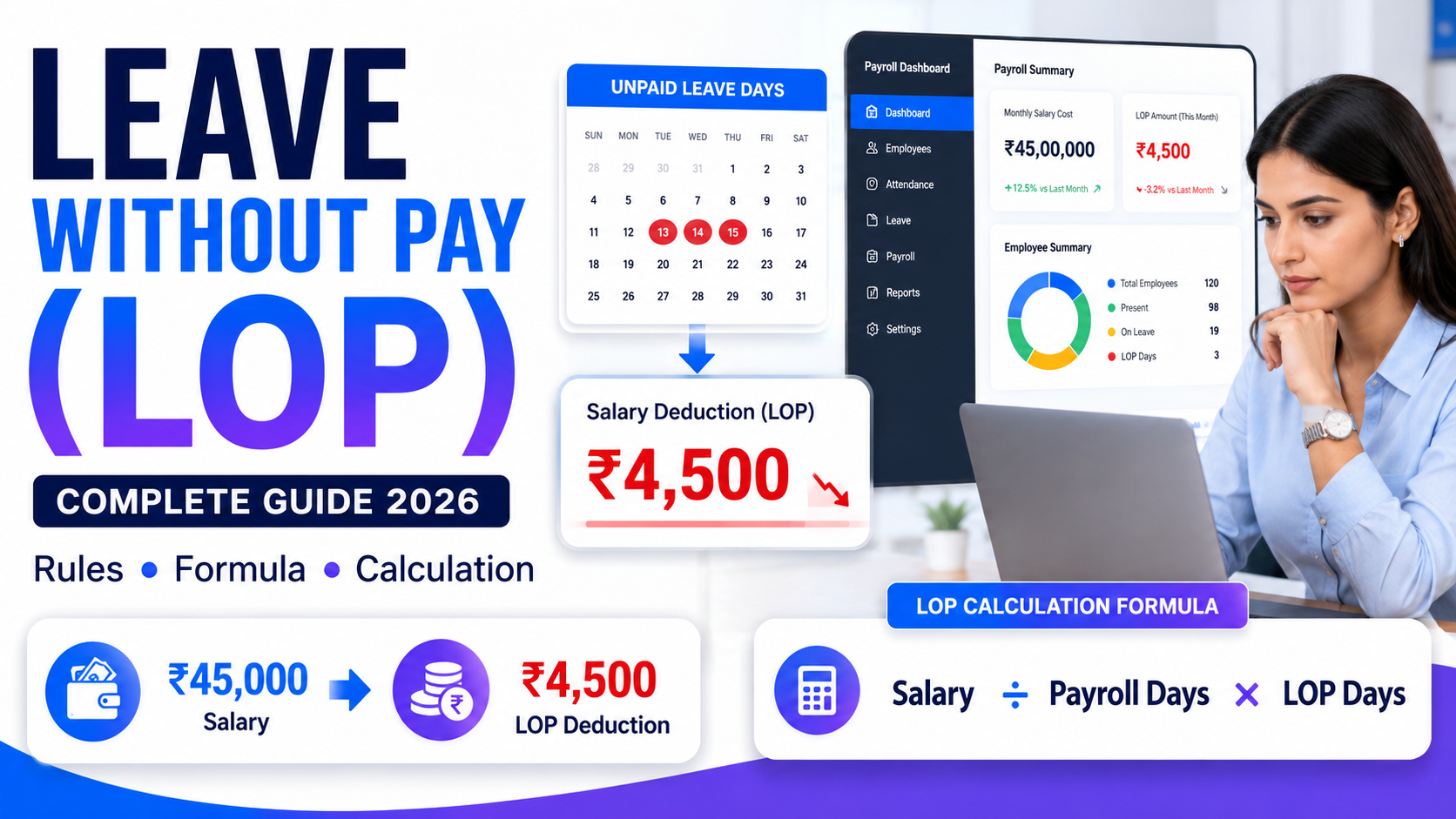
LOP Calculation Formula
LOP Deduction = Monthly Gross Salary ÷ Applicable Payroll Days × LOP DaysWhere
- Monthly Gross Salary = Employee’s monthly salary used for payroll calculations
- Applicable Payroll Days = 30 days, calendar days, working days, or another organization-defined method
- LOP Days = Number of approved unpaid leave days
The payroll calculation method should always be clearly defined in the organization’s payroll policy.
Loss of Pay Calculation Example
Suppose an employee has:
| Component | Value |
|---|---|
| Monthly Gross Salary | ₹45,000 |
| Payroll Days | 30 |
| LOP Days | 3 |
Step 1: Calculate Daily Salary
₹45,000 ÷ 30 = ₹1,500Step 2: Calculate LOP Deduction
₹1,500 × 3 = ₹4,500Total LOP Deduction
₹4,500
Note: Depending on the organization’s payroll policy or applicable labour laws, the method used to calculate LOP may differ.
Does Loss of Pay Affect Payroll?
Yes. Since LOP represents unpaid leave, it directly impacts payroll processing.
Loss of Pay may affect:
- Monthly salary
- Overtime calculations
- Attendance records
- Leave balances
- Attendance incentives and bonuses
- Performance-linked compensation
- Full & Final Settlement calculations
Accurately tracking LOP helps prevent payroll discrepancies and employee disputes.
Best Practices for Managing Loss of Pay
A transparent LOP policy helps maintain consistency and fairness across the organization.
HR teams should:
- Clearly define eligibility for unpaid leave
- Specify approval authorities and workflows
- Explain how salary deductions are calculated
- Communicate leave and attendance policies
- Track LOP using an HRMS
- Maintain payroll and audit records
- Ensure compliance with organizational policies and applicable labour laws
Simplify Loss of Pay Management with ZestNexus HRMS
Managing unpaid leave manually increases the risk of payroll errors and administrative effort.
ZestNexus HRMS helps organizations:
- Automatically identify insufficient leave balances
- Generate Loss of Pay based on company policies
- Configure custom LOP rules
- Manage attendance, leave, and payroll from one platform
- Calculate salary deductions automatically
- Route leave requests through approval workflows
- Provide employees with real-time leave balances through the Employee Self-Service (ESS) portal
- Generate payroll-ready reports
By integrating leave management with payroll, ZestNexus reduces manual work, minimizes payroll discrepancies, and improves transparency for both HR teams and employees.
Final Thoughts
Loss of Pay is an essential part of leave and payroll management. It helps organizations accurately account for unpaid absences while maintaining transparent payroll and attendance records.
A clearly defined LOP policy, combined with an automated HRMS like ZestNexus, enables businesses to reduce payroll errors, improve compliance, simplify approvals, and provide employees with a seamless leave management experience.
Frequently Asked Questions
What is Loss of Pay (LOP)?
Loss of Pay (LOP) refers to unpaid leave recorded when an employee has exhausted their paid leave balance or when leave is categorized as unpaid according to the organization’s leave policy.
Are LOP and Leave Without Pay (LWP) the same?
Yes. The terms Loss of Pay (LOP) and Leave Without Pay (LWP) are commonly used interchangeably to describe unpaid leave.
How is LOP calculated?
LOP is generally calculated using the formula:
LOP Deduction = Monthly Salary ÷ Applicable Payroll Days × LOP DaysThe payroll days used depend on the organization’s payroll policy.
Does LOP affect salary?
Yes. Each approved LOP day results in a proportional salary deduction based on the organization’s payroll calculation method.
Can LOP be automated?
Yes. HRMS platforms like ZestNexus automate leave tracking, attendance, approval workflows, payroll integration, and LOP calculations, reducing manual effort and payroll errors.
Similar blogs you may like