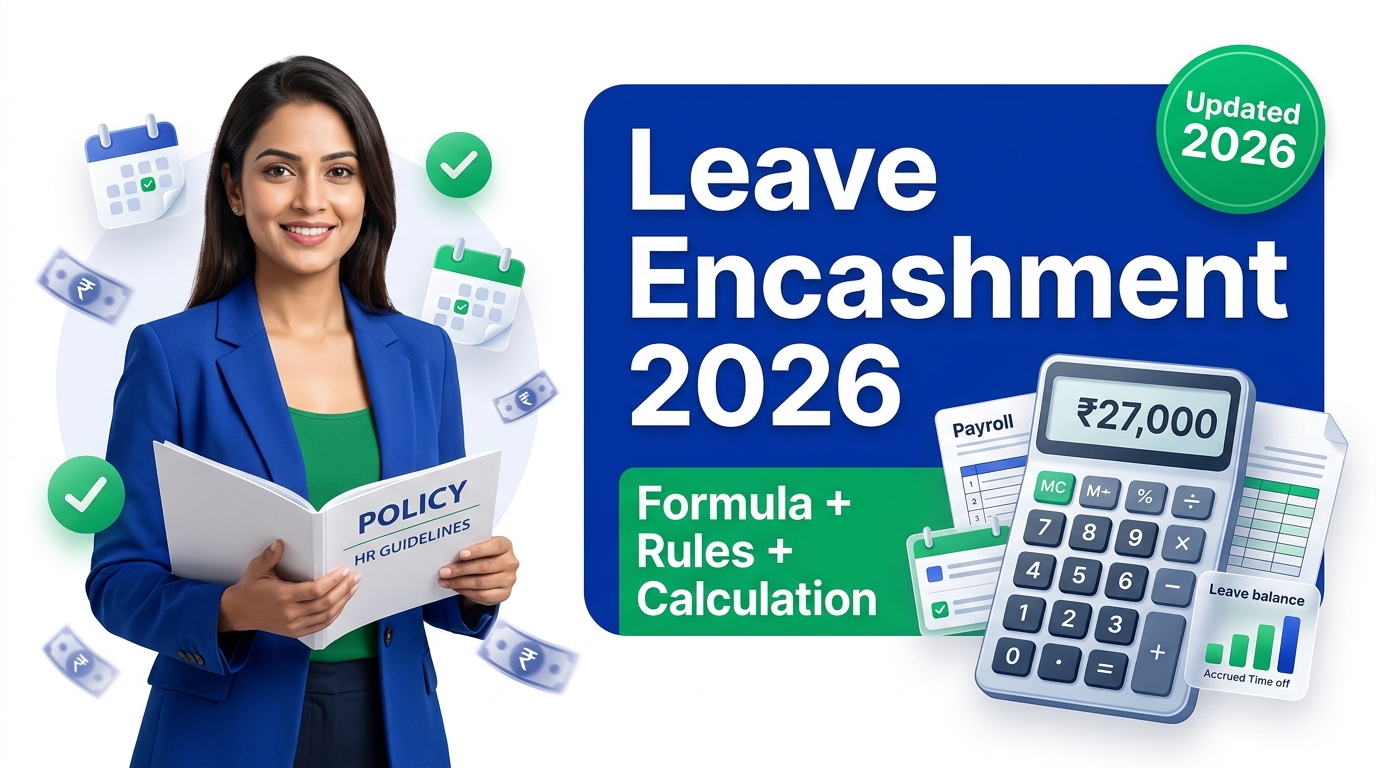
Leave Encashment in India: Meaning, Rules, Formula & Calculation (2026 Guide)
Learn everything about leave encashment in India, including eligibility, calculation formula, tax implications, examples, and company policies.
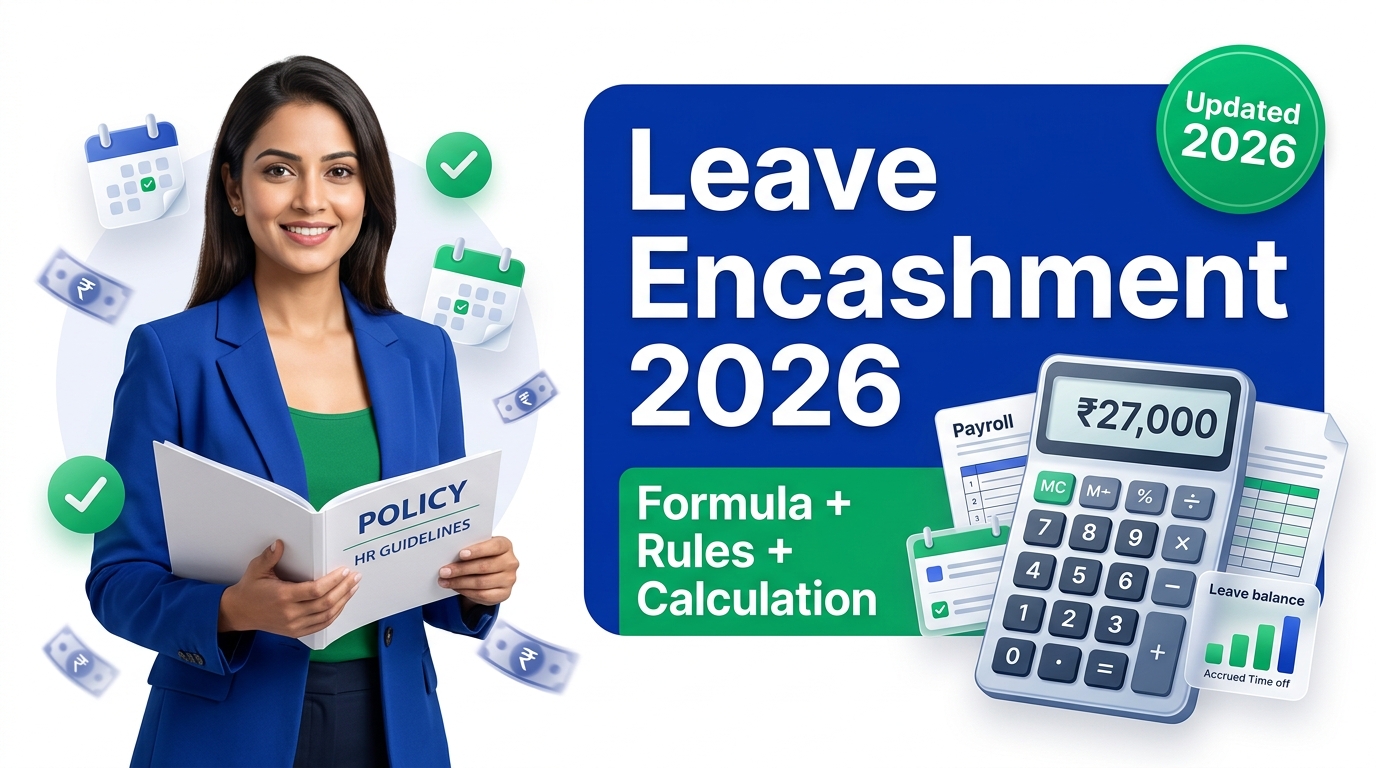
Leave management is one of the most important HR and payroll processes in every organization. While employees generally utilize their paid leave for vacations, personal commitments, or emergencies, there are situations where unused leave can be converted into monetary compensation. This process is known as Leave Encashment.
Understanding leave encashment is essential for HR professionals, payroll administrators, and business owners to ensure accurate payroll processing and compliance with applicable labor and tax regulations.
In this guide, you’ll learn:
- What leave encashment means
- Which types of leave can be encashed
- Leave encashment calculation formula
- Tax implications
- Practical examples
- Best practices for organizations
What Is Leave Encashment?
Leave encashment is the process of compensating employees for eligible unused leave instead of allowing them to take time off.
Rather than letting accumulated earned leave lapse, employers provide a monetary payment based on the employee’s salary and the organization’s leave policy.
Leave encashment generally occurs in the following situations:
- Employee resignation
- Retirement or superannuation
- Termination of employment
- During active employment (if permitted by company policy)
Its primary purpose is to compensate employees for earned leave they could not utilize.
Types of Leave Eligible for Encashment
Not every leave type qualifies for leave encashment. Eligibility depends on organizational policies and applicable labor laws.
1. Earned Leave (EL) / Privilege Leave (PL)
Earned Leave (EL) or Privilege Leave (PL) is the most commonly encashable leave in India.
These leaves accumulate over an employee’s period of service.
Most organizations allow encashment:
- During employment (if company policy allows)
- At resignation
- Upon retirement
- At the end of employment
2. Casual Leave (CL)
Casual Leave is granted for short-term personal requirements.
Most organizations do not allow casual leave encashment. Unused balances generally lapse at the end of the leave year.
3. Sick Leave (SL)
Sick Leave is provided for illness or medical emergencies.
Whether sick leave can be encashed depends entirely on the employer’s leave policy. Many companies do not allow encashment.
4. Maternity Leave
Paid maternity leave is governed by the Maternity Benefit Act.
It is intended for childbirth and recovery and is generally not encashable, unless specifically allowed under company policy.
5. Paternity Leave
Paternity leave is granted by some organizations for new fathers.
It is typically not eligible for encashment.
6. Bereavement Leave
Bereavement leave is provided following the death of a close family member.
Since it serves a specific purpose, it is generally not encashable.
7. Floater or Festival Leave
Many organizations offer optional holidays based on employees’ cultural or religious preferences.
Unused floater leave usually expires and cannot be encashed.
8. Marriage Leave
Marriage leave is offered by some employers as a one-time benefit.
It is generally not eligible for encashment.
9. Sabbatical Leave
Sabbatical leave is intended for long-term career breaks, education, or personal development.
It is not typically converted into financial compensation.
Leave Encashment Eligibility Summary
| Leave Type | Can It Be Encashed? |
|---|---|
| Earned Leave (EL) | ✅ Yes |
| Privilege Leave (PL) | ✅ Yes |
| Casual Leave | ❌ Usually No |
| Sick Leave | Depends on Company Policy |
| Maternity Leave | Depends on Company Policy |
| Paternity Leave | ❌ No |
| Bereavement Leave | ❌ No |
| Floater Leave | ❌ No |
| Marriage Leave | ❌ No |
| Sabbatical Leave | ❌ No |
| National Holidays | ❌ No |
How Is Leave Encashment Calculated?
Leave encashment is calculated using the employee’s eligible salary components and the number of unused encashable leave days.
Leave Encashment Formula
Leave Encashment =
(Basic Salary + Dearness Allowance) ÷ 30 × Number of Eligible Leave Days
Where
- Basic Salary = Monthly Basic Pay
- Dearness Allowance (DA) = Included where applicable
- 30 = Standard number of days considered for calculation
- Eligible Leave Days = Approved unused leave available for encashment
Leave Encashment Calculation Example
Consider the following employee details:
| Component | Amount |
|---|---|
| Basic Salary | ₹40,000 |
| Dearness Allowance | ₹5,000 |
| Unused Earned Leave | 18 Days |
Step 1: Calculate Daily Salary
(₹40,000 + ₹5,000) ÷ 30
= ₹1,500 per day
Step 2: Multiply by Eligible Leave Days
₹1,500 × 18
= ₹27,000
Total Leave Encashment
₹27,000
Is Leave Encashment Taxable?
Yes. The tax treatment depends on when the employee receives the payment.
During Employment
Leave encashment received while an employee is actively employed is generally taxable as salary income under the Income Tax Act.
At Retirement
Leave encashment received upon retirement or superannuation may qualify for tax exemption, subject to the applicable provisions and exemption limits under the Income Tax Act.
Employees should consult a tax advisor or payroll expert for individual tax planning.
Why Accurate Leave Management Matters
Managing leave manually often results in:
- Incorrect leave balances
- Payroll calculation errors
- Employee disputes
- Compliance risks
- Increased administrative workload
Automating leave management helps organizations:
- Track leave accurately
- Reduce payroll errors
- Maintain policy compliance
- Improve employee experience
- Save HR teams valuable time
Simplify Leave Encashment with ZestNexus HRMS
Calculating leave encashment manually becomes increasingly complex as organizations grow and adopt different leave policies.
ZestNexus HRMS automates the complete leave lifecycle by helping organizations:
- Automatically calculate leave accruals
- Configure custom leave policies
- Track employee leave balances in real time
- Calculate leave encashment accurately
- Integrate leave data directly with payroll
- Generate HR and finance reports
- Maintain organizational compliance
By eliminating manual calculations, HR teams can process payroll faster while ensuring employees receive accurate payments every time.
Final Thoughts
Leave encashment is an important employee benefit that rewards employees for unused earned leave while promoting transparency in payroll practices.
Organizations should establish a clear leave encashment policy that defines:
- Eligible leave types
- Encashment conditions
- Calculation methods
- Tax treatment
- Compliance requirements
Using an automated HRMS like ZestNexus simplifies leave tracking, payroll integration, and leave encashment calculations, reducing manual effort and improving both HR efficiency and employee satisfaction.
Frequently Asked Questions
What is leave encashment?
Leave encashment is the monetary compensation paid to employees for eligible unused leave instead of allowing the leave to remain unused or lapse.
Which leave can usually be encashed?
Earned Leave (EL) and Privilege Leave (PL) are the most commonly encashable leave types in India.
Is casual leave encashable?
Generally, no. Most organizations do not permit casual leave encashment, and unused balances expire.
What is the formula for leave encashment?
(Basic Salary + Dearness Allowance)
÷ 30
× Number of Eligible Leave Days
Is leave encashment taxable?
- During employment, leave encashment is generally taxable as salary income.
- At retirement, it may qualify for tax exemptions subject to applicable Income Tax provisions.
Similar blogs you may like