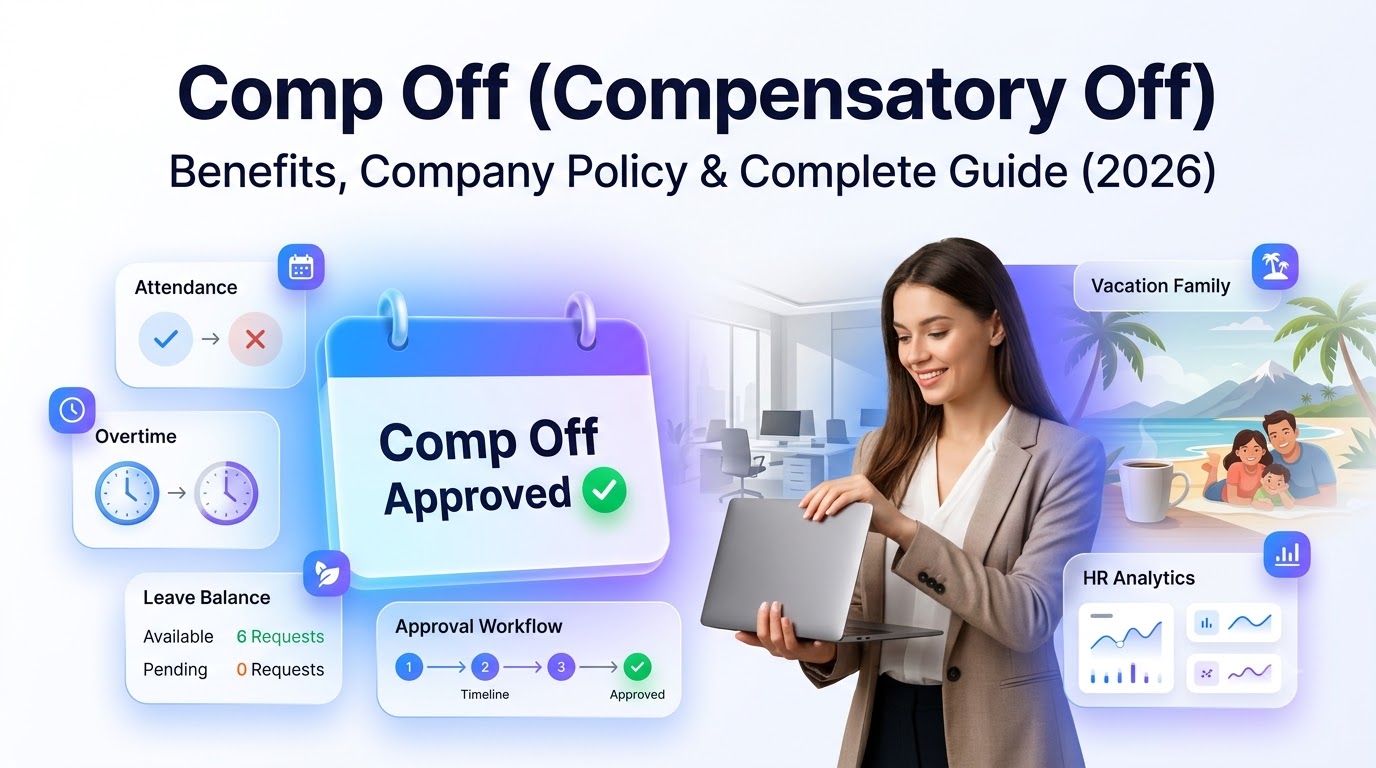
Comp Off (Compensatory Off): Benefits, Meaning & Company Policy Guide
Learn what Comp Off (Compensatory Off) means, who is eligible, its benefits, company policy best practices, FAQs, and how to manage compensatory leave efficiently with HRMS.
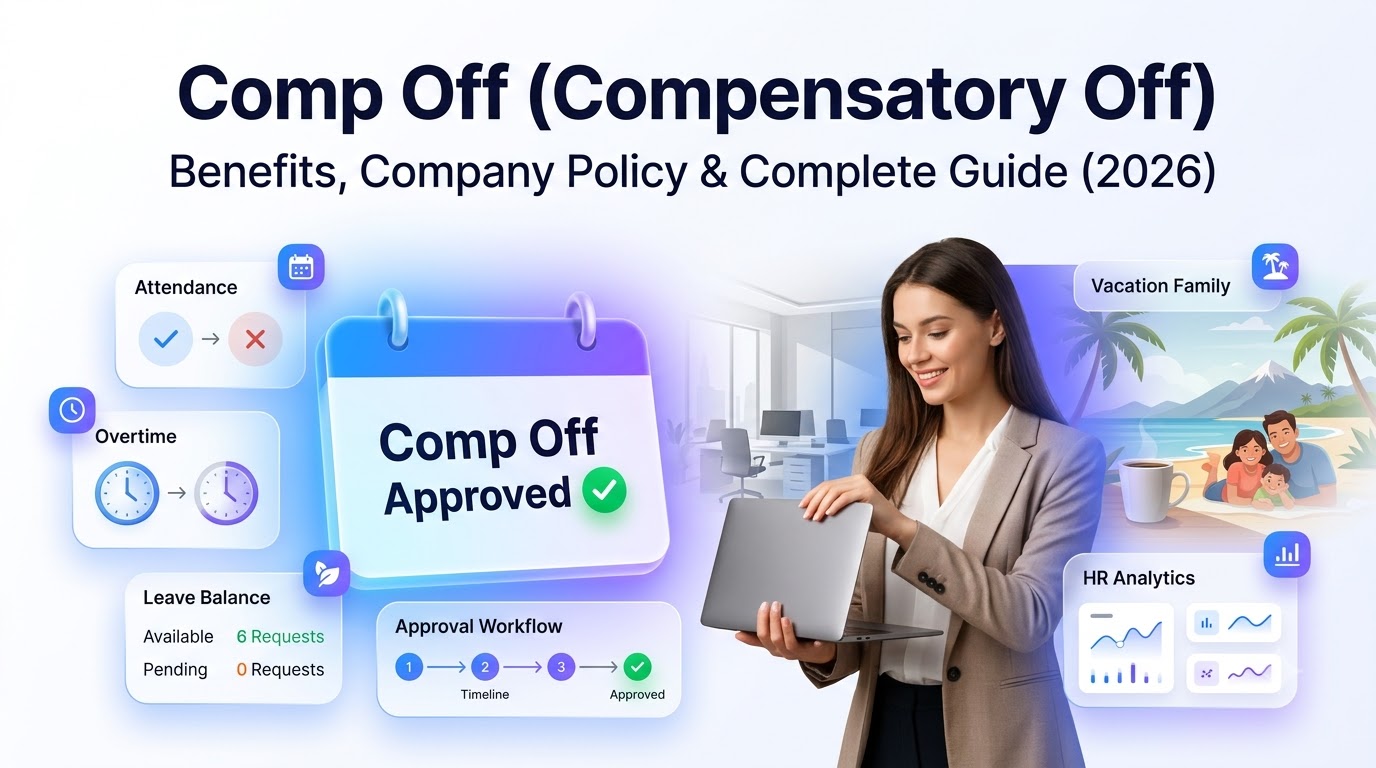
Employees often put in extra effort by working on weekends, public holidays, or beyond their scheduled working hours. Instead of paying overtime wages, many organizations reward employees with Compensatory Off (Comp Off)—a paid leave that can be availed later.
A well-defined *Comp Off policy- helps organizations recognize employee contributions while maintaining operational flexibility and promoting a healthy work-life balance.
In this guide, you’ll learn:
- What Comp Off means
- Who is eligible
- Benefits for employees and employers
- Comp Off vs Overtime
- Best policy practices
- Frequently Asked Questions
What Is Comp Off?
Compensatory Off (Comp Off) is a paid leave granted to employees who work on:
- Weekly off days
- Public holidays
- Beyond their regular working hours (with approval)
Instead of receiving overtime pay, employees earn leave that they can utilize later.
Example
Suppose an employee works on a Sunday due to an urgent client deployment. Rather than paying overtime, the company may grant one compensatory leave, which the employee can use on another working day.
💡 Tip: Comp Off recognizes employees for their additional effort while helping maintain a healthier work-life balance.
Who Can Avail Comp Off?
Eligibility depends on the company’s HR policy. Generally, employees qualify when they:
- Work on a declared public holiday
- Work on their scheduled weekly off
- Perform approved overtime beyond regular working hours
- Are specifically instructed by their reporting manager to work extra
Many organizations only approve Comp Off when prior authorization has been obtained.
Why Do Companies Offer Comp Off?
Organizations use compensatory leave to reward employees without always incurring overtime expenses.
A transparent Comp Off policy helps:
- Appreciate employee efforts
- Improve workplace flexibility
- Encourage employees during business-critical periods
- Promote a positive work culture
Benefits of Comp Off for Organizations
1. Better Cost Management
Rather than paying overtime for every additional hour worked, businesses can reward employees with paid leave, helping optimize payroll costs.
2. Improved Workforce Flexibility
Organizations can handle:
- Seasonal demand
- Unexpected workloads
- Client emergencies
- Business-critical projects
without significantly increasing labor costs.
3. Higher Employee Engagement
Employees are more willing to support business needs when they know their extra effort will be recognized.
4. Reduced Employee Burnout
Providing paid time off after extended work periods allows employees to recover, improving well-being and long-term productivity.
5. Stronger Employee Retention
Employees who feel valued are more satisfied and are less likely to leave the organization.
Benefits of Comp Off for Employees
Extra Paid Leave
Employees receive additional paid leave without affecting their salary.
Better Work-Life Balance
Comp Off allows employees to:
- Spend time with family
- Attend personal commitments
- Recharge after demanding work periods
Flexible Time Off
Employees can utilize earned leave according to company approval and business requirements.
Recognition for Extra Effort
Compensatory leave demonstrates that the organization values employee commitment.
Increased Productivity
Proper rest enables employees to return with improved energy, motivation, and focus.
Comp Off vs Overtime Pay
| Feature | Comp Off | Overtime Pay |
|---|---|---|
| Compensation | Paid leave | Additional salary |
| Best Suited For | Organizations promoting work-life balance | Organizations legally or contractually required to pay overtime |
| Payroll Impact | No immediate payroll increase | Increases payroll costs |
| Benefit Timing | Leave can be used later | Compensation included in salary |
The choice between Comp Off and overtime pay depends on company policy, employment contracts, and applicable labor laws.
Best Practices for Managing Comp Off
For Employees
✅ Do
- Obtain approval before working extra hours whenever possible.
- Apply for Comp Off within the validity period.
- Understand your organization’s Comp Off policy.
- Plan leave with your manager to avoid business disruption.
❌ Don’t
- Assume every extra hour automatically qualifies.
- Allow earned Comp Off to expire.
- Submit last-minute leave requests without planning.
For Employers
✅ Do
- Maintain a clearly documented Comp Off policy.
- Define eligibility criteria and approval workflows.
- Track Comp Off earned and utilized.
- Apply policies consistently across departments.
❌ Don’t
- Use inconsistent approval standards.
- Make approvals unnecessarily complicated.
- Prevent employees from utilizing earned Comp Off.
How to Create an Effective Comp Off Policy
A successful compensatory leave policy should balance organizational needs with employee well-being.
1. Define Objectives
Clearly identify whether the policy aims to:
- Improve employee satisfaction
- Reduce overtime costs
- Increase operational flexibility
2. Establish Eligibility Rules
Clearly define:
- Eligible employee categories
- Qualifying work conditions
- Minimum additional hours required
- Approval authorities
3. Ensure Legal Compliance
Ensure the policy complies with:
- Employment laws
- Labor regulations
- Industry-specific compliance requirements
4. Define Usage Rules
Specify:
- Validity period
- Maximum accumulation limit
- Approval workflow
- Documentation requirements
- Expiry conditions
5. Gather Employee Feedback
Consult managers and employees before finalizing the policy to ensure fairness and practicality.
6. Communicate the Policy
Publish the policy through:
- Employee handbook
- HRMS portal
- Internal knowledge base
- Onboarding documentation
Simplify Comp Off Management with ZestNexus HRMS
Managing compensatory leave manually becomes increasingly difficult as organizations grow. Tracking approvals, attendance, overtime, and leave balances across multiple teams can quickly become time-consuming and error-prone.
ZestNexus HRMS automates the entire Comp Off process by integrating attendance, overtime tracking, leave management, and approval workflows into a single platform.
With ZestNexus, HR teams can:
- Automate attendance tracking
- Capture approved overtime
- Manage Comp Off requests digitally
- Configure approval workflows
- Track leave balances in real time
- Generate comprehensive HR reports
- Ensure transparency for employees and managers
Whether you’re a growing startup or a large enterprise, ZestNexus simplifies workforce management, reduces administrative effort, and delivers a seamless employee experience—all from one unified HRMS platform.
✅ Best Practice: A well-designed Comp Off policy not only rewards employees for their extra effort but also supports healthier work-life balance, improved engagement, and operational efficiency. Pairing a clear policy with an automated HRMS ensures transparency, compliance, and hassle-free leave management.
Frequently Asked Questions
What is Comp Off?
Comp Off (Compensatory Off) is paid leave granted to employees who work on weekends, public holidays, or approved extra working hours instead of receiving overtime pay.
Who is eligible for Comp Off?
Eligibility depends on the organization’s HR policy. Employees typically qualify when they work on weekly off days, public holidays, or approved overtime with prior authorization.
Can Comp Off expire?
Yes. Most organizations require employees to use Comp Off within a specified period, such as 30, 60, or 90 days, after which it may expire.
Can unused Comp Off be carried forward?
It depends on the company’s leave policy. Some employers allow carry-forward, while others require employees to use Comp Off before its validity period ends.
Is Comp Off legally mandatory?
Labour laws vary by country, industry, and employee category. Some employees may be legally entitled to overtime pay instead of compensatory leave, depending on applicable regulations.
What records should employers maintain for Comp Off?
Organizations should maintain records of additional work dates, hours worked, manager approvals, Comp Off earned, leave utilized, and the remaining balance for each employee.
What is the difference between Comp Off and overtime pay?
Comp Off provides paid leave that employees can use later, whereas overtime pay compensates employees with additional wages for extra hours worked. The appropriate option depends on company policy and applicable labour laws.
Similar blogs you may like