On-Roll vs Off-Roll Payroll: The Simple Difference
Learn the key differences between on-roll and off-roll payroll, including employment status, benefits, compliance, and which payroll model is best for your business.
Choosing the right talent is only one part of effective workforce management. Equally important is selecting the right payroll model, as it directly impacts employee benefits, statutory compliance, payroll administration, and overall business efficiency.
Most organizations operate using two primary employment models:
- On-Roll Payroll
- Off-Roll Payroll
Although both models compensate employees for their work, they differ significantly in terms of employment status, benefits, employer responsibilities, and workforce flexibility.
This guide explains the differences between on-roll and off-roll payroll to help businesses make informed hiring decisions.
What Is On-Roll Payroll?
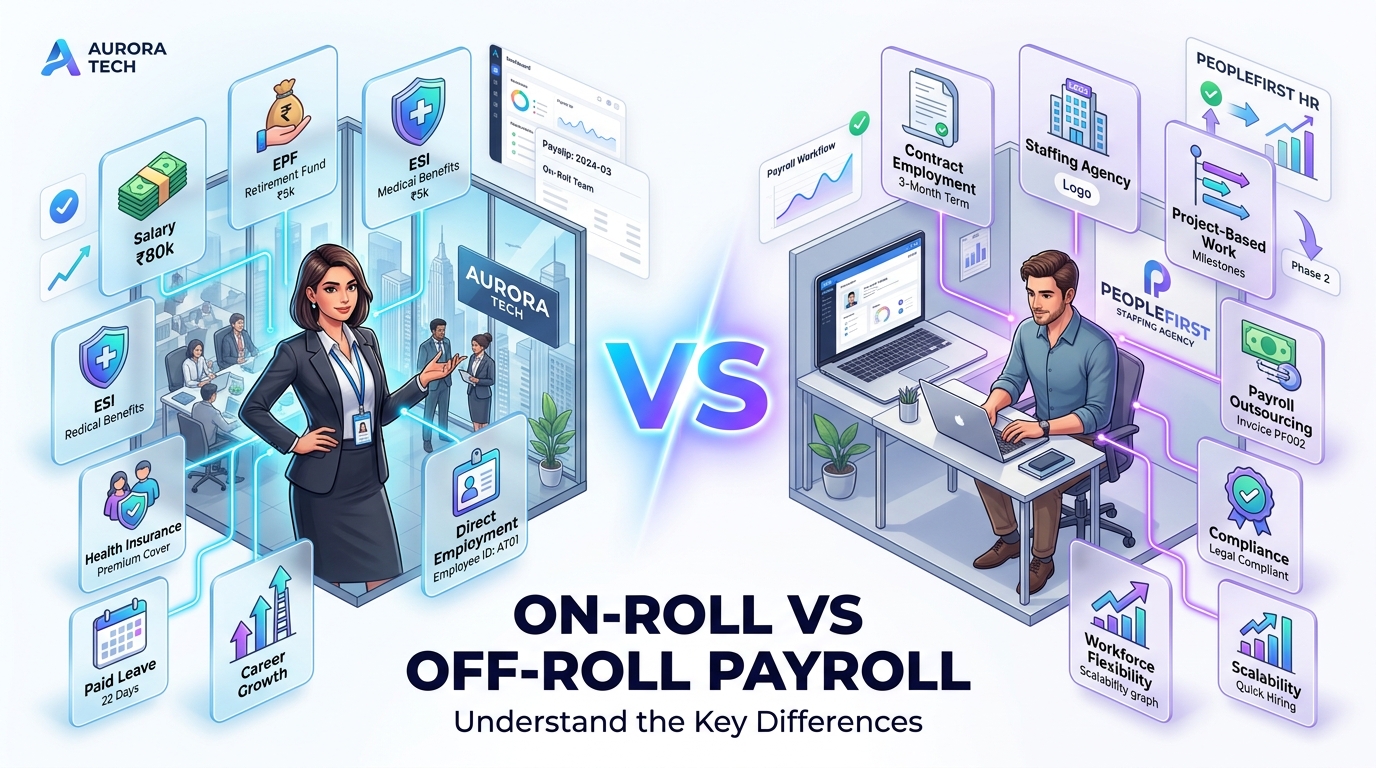
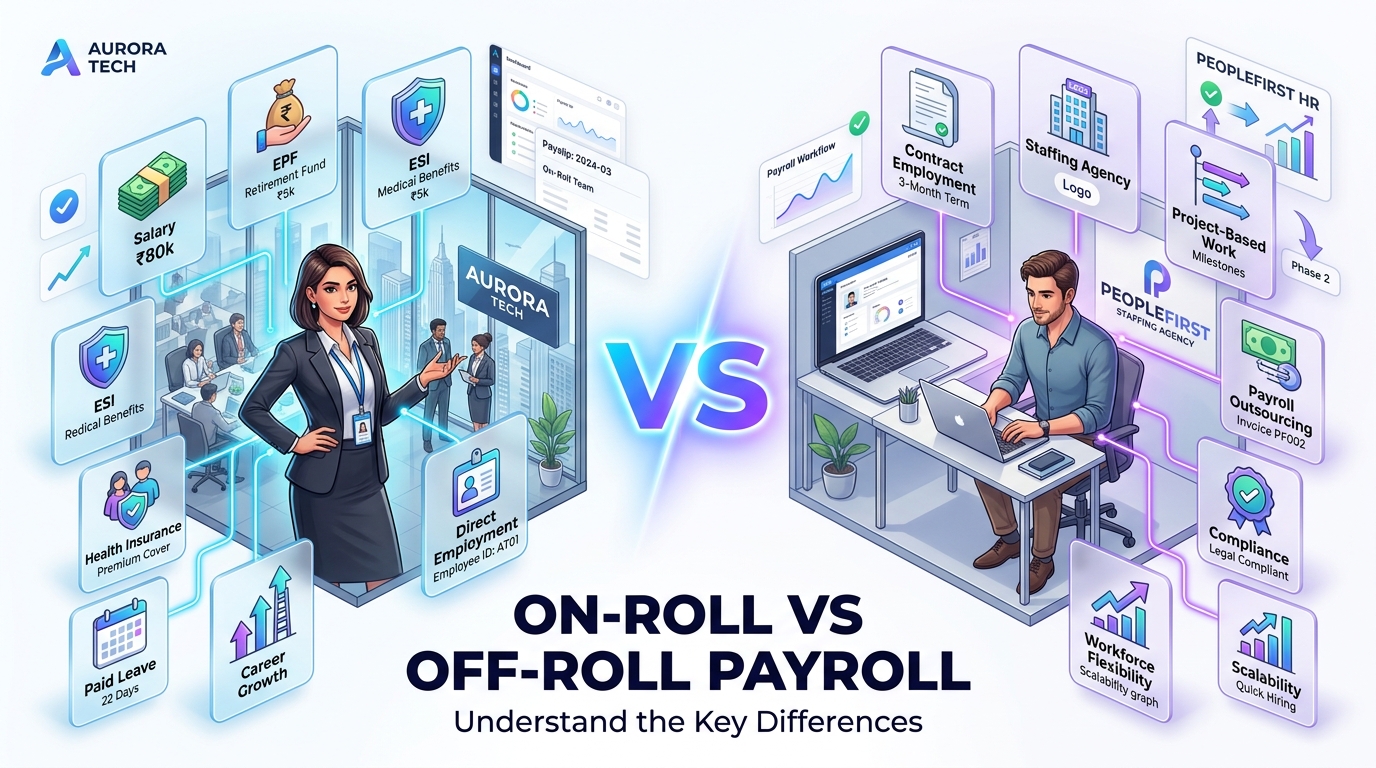
An on-roll employee is directly employed by the organization. They are part of the company’s payroll, receive a fixed salary, and are entitled to both statutory and company-provided benefits.
Key Features of On-Roll Payroll
- Direct employment with the organization
- Fixed monthly salary
- Eligible for statutory benefits such as EPF and ESI (where applicable)
- Access to company benefits like health insurance, paid leave, bonuses, and allowances
- Covered under company HR policies and performance management
- Ideal for permanent and long-term roles
What Is Off-Roll Payroll?
An off-roll employee works for an organization but is employed through a third-party staffing agency, payroll provider, or contractor. While they perform work for the client company, payroll processing, statutory compliance, and employment responsibilities are handled by the third-party employer.
Key Features of Off-Roll Payroll
- Employed through a staffing agency or payroll outsourcing partner
- Salary processed by the third-party employer
- Benefits vary depending on the employer and employment agreement
- Best suited for temporary, contractual, seasonal, or project-based roles
- Enables businesses to scale their workforce quickly with lower administrative overhead
On-Roll vs Off-Roll Payroll: Comparison
| Feature | On-Roll Payroll | Off-Roll Payroll |
|---|---|---|
| Employment | Directly employed by the company | Employed through a third-party provider |
| Payroll Management | Managed internally | Managed by a staffing or payroll partner |
| Salary | Paid directly by the employer | Paid by the third-party employer |
| Employee Benefits | Eligible for statutory and company benefits | Benefits depend on the third-party employer |
| HR Policies | Covered under company HR policies | Governed by the third-party employer’s policies |
| Best For | Permanent employees | Contract, project-based, and temporary staffing |
Why Companies Choose Off-Roll Payroll
Many organizations prefer off-roll payroll because it offers flexibility while reducing administrative responsibilities.
Benefits of Off-Roll Payroll
- Faster hiring for short-term projects
- Reduced payroll administration
- Simplified statutory compliance
- Access to specialized talent when needed
- Easier workforce scaling during seasonal demand
- Allows HR teams to focus on strategic initiatives rather than administrative tasks
Which Payroll Model Is Best for Your Business?
The right payroll model depends on your organization’s hiring strategy and business objectives.
Choose On-Roll Payroll If You Need
- Long-term employees
- Better employee engagement
- Career development opportunities
- Strong organizational culture
- Greater employee retention
Choose Off-Roll Payroll If You Need
- Workforce flexibility
- Project-based hiring
- Seasonal staffing
- Faster recruitment
- Payroll and compliance outsourcing
Many growing businesses successfully use a hybrid workforce model, combining both on-roll and off-roll employees to balance stability with flexibility.
How ZestNexus Can Help
Managing payroll doesn’t have to be complicated.
ZestNexus provides modern payroll and workforce management solutions that help businesses streamline payroll processing, maintain statutory compliance, and efficiently manage both permanent and contract employees.
With ZestNexus, organizations can:
- Automate payroll processing
- Ensure statutory compliance
- Reduce manual administrative work
- Manage contract and permanent employees from one platform
- Improve payroll accuracy
- Save valuable HR time
Whether you’re building a permanent workforce or hiring skilled professionals on contract, ZestNexus simplifies payroll management so you can focus on growing your business.
Final Thoughts
Understanding the differences between on-roll and off-roll payroll enables businesses to build a workforce strategy that aligns with their operational goals.
While on-roll employment offers stability, employee engagement, and long-term commitment, off-roll payroll provides flexibility, scalability, and simplified administration.
By selecting the right payroll model—and partnering with a trusted payroll provider like ZestNexus—organizations can improve efficiency, ensure compliance, and support sustainable business growth.
Frequently Asked Questions
What is the difference between payroll, on-roll, and off-roll?
Payroll is the process of calculating employee salaries, deductions, taxes, reimbursements, and statutory contributions.
- On-roll employees are directly employed by the company.
- Off-roll employees work for the company but are employed through a third-party staffing or payroll provider.
Why do companies hire employees through third-party payroll?
Companies use third-party payroll providers to simplify recruitment, payroll processing, compliance, tax calculations, and HR administration while improving workforce flexibility and operational efficiency.
Do off-roll employees receive statutory benefits?
Yes. If required by applicable labor laws, third-party employers generally provide statutory benefits such as EPF and ESI. Eligibility depends on the employment agreement and applicable regulations.
Is off-roll payroll legal in India?
Yes. Off-roll employment is legal in India when managed in compliance with applicable labor laws and statutory regulations. Organizations should ensure their staffing or payroll partner fulfills all legal obligations.
Which is better: on-roll or off-roll payroll?
Neither model is universally better. On-roll payroll is ideal for permanent employees and long-term workforce planning, while off-roll payroll is better suited for contract staffing, project-based hiring, and workforce flexibility. Many businesses benefit from using both models together.
Similar blogs you may like