Conveyance Allowance: Meaning, Exemption, Calculation & Tax Rules in India
Understand conveyance allowance in India, including calculation methods, tax exemption rules, the new tax regime, and PF and ESI treatment.
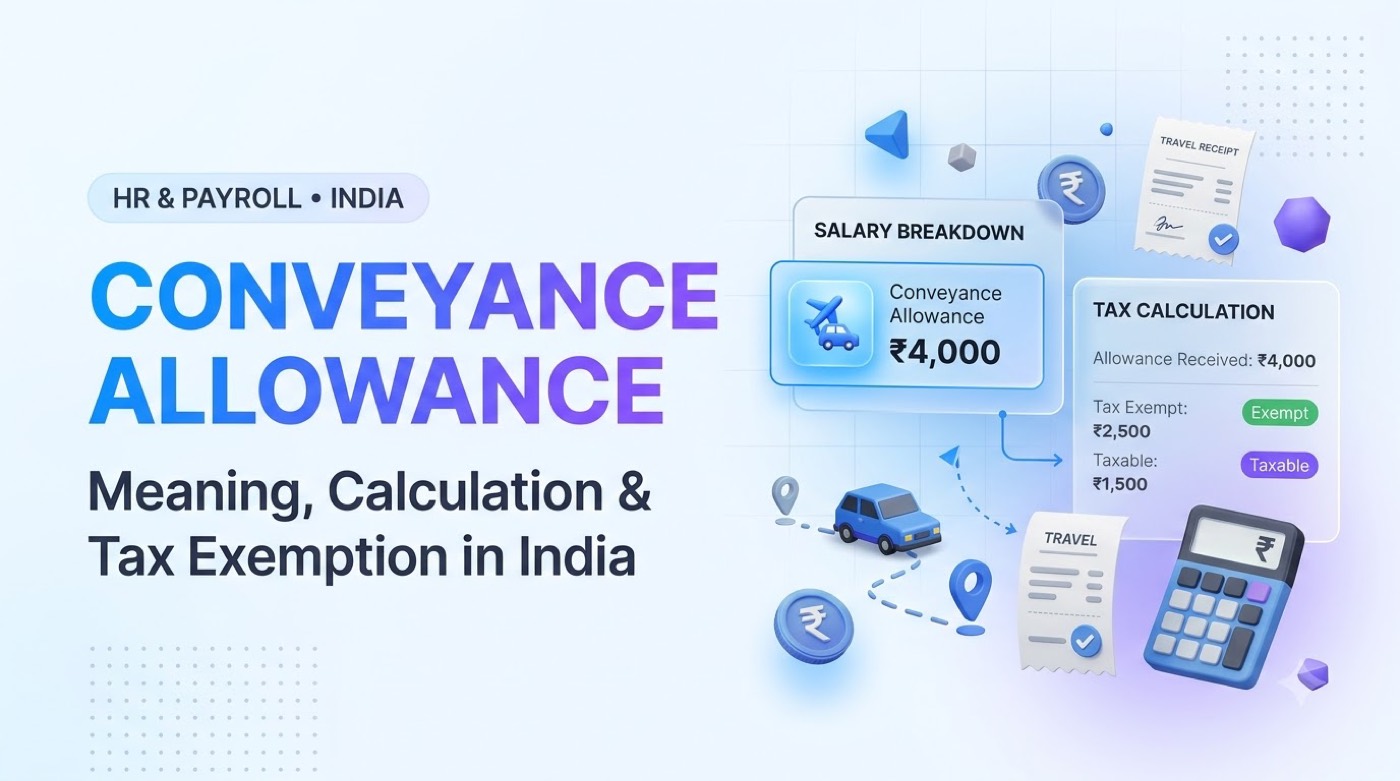
Employees can receive more than just their base pay. Many companies structure employee salaries with different types of allowances designed to reimburse work-related expenses and provide additional income. One such allowance is conveyance allowance.
Employees who travel on behalf of their company to meet clients, attend company-sponsored events, or visit different office locations may incur various travel expenses. Conveyance allowance helps employees manage these official travel costs.
But is conveyance allowance considered a benefit and therefore subject to taxation? Can employees claim a tax exemption on it? How do employers calculate conveyance allowance, and what guidelines should they follow when incorporating it into their payroll system?
In this article, we will explain the meaning of conveyance allowance, how to calculate it, its tax treatment, applicable exemptions, and the difference between conveyance allowance and transport allowance in India.
What Is Conveyance Allowance?
An employer provides conveyance allowance to employees to help cover the cost of travelling for official or job-related activities.
These expenses may include:
- Travelling to client offices or customer locations.
- Attending official meetings outside the workplace.
- Visiting different branches, project sites, or business locations.
- Travelling between locations as part of assigned work responsibilities.
For example, a salesperson who regularly visits clients or a field employee who travels between different job sites may receive conveyance allowance to cover business-related travel expenses.
Employers may include this benefit as a separate component in an employee’s salary structure. The amount may be predetermined based on the organisation’s travel and reimbursement policies or provided as a fixed allowance.
It is important to understand that conveyance allowance for official travel is different from the cost of travelling between an employee’s residence and regular workplace.
How Is Conveyance Allowance Calculated?
There is no single standard amount for conveyance allowance in the private sector. Employers generally determine the amount based on:
- Employee’s job responsibilities.
- Frequency and nature of official travel.
- Company reimbursement and compensation policies.
- Overall salary structure of the organisation.
Some common methods of calculating conveyance allowance include:
1. Fixed Monthly Allowance
An employer may provide a fixed amount every month to employees who regularly travel for official duties.
Example:
A company may provide its sales executives with ₹2,000 per month to cover expenses incurred while visiting clients.
2. Actual Expense-Based Reimbursement
Instead of providing a fixed amount, employers may reimburse employees for the actual out-of-pocket expenses incurred during business travel.
Employees may need to submit supporting documents, such as:
- Travel receipts.
- Bills and invoices.
- Expense reports.
- Other relevant travel documentation.
3. Distance-Based Allowance
Companies employing field workers may calculate travel expenses based on the distance travelled, the reimbursement rate per kilometre, or the mode of transportation used.
For example, an organisation may establish different reimbursement rates for employees travelling through:
- Employee-owned vehicles.
- Taxis.
- Public transportation.
Employers should maintain a clear and documented allowance or reimbursement policy to ensure consistency and accurate reporting in employee payroll records.
Is Conveyance Allowance Taxable in India?
Conveyance allowance is generally taxable because it forms part of an employee’s earnings. However, an exemption may be available when the allowance is provided to meet expenses incurred while performing official duties.
Under the Income Tax Act, 1961, this exemption was covered under Section 10(14)(i) read with Rule 2BB of the Income Tax Rules, 1962.
From April 1, 2026, the Income-tax Act, 2025 and Income-tax Rules, 2026 apply in India. The corresponding provisions for eligible official-duty allowances are included under Schedule III of the new Act and Rule 280 of the Income-tax Rules, 2026.
The primary principle remains that qualifying conveyance allowance is exempt only to the extent of actual expenditure incurred for official purposes.
Important: To claim this exemption, the employer must not have separately provided transportation for the same official journey.
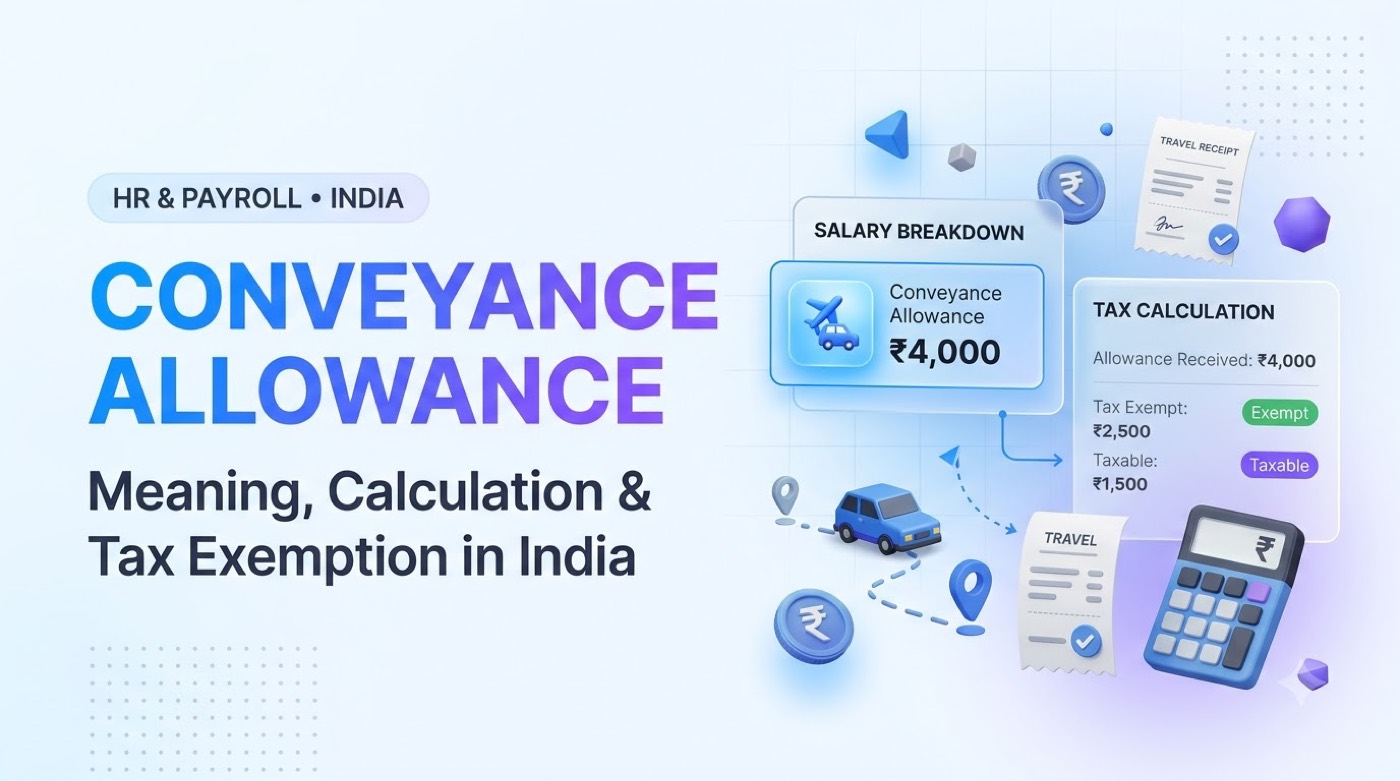
Example of Conveyance Allowance Tax Calculation
Suppose an employee receives ₹4,000 per month as conveyance allowance but spends only ₹2,500 on eligible official travel.
The tax treatment would be:
| Particulars | Amount |
|---|---|
| Monthly conveyance allowance received | ₹4,000 |
| Actual eligible official travel expenses | ₹2,500 |
| Exempt amount | ₹2,500 |
| Taxable amount | ₹1,500 |
The unused portion of the allowance, in this case ₹1,500, is added to the employee’s taxable salary.
Conveyance Allowance Tax Exemption Under the New Tax Regime
The taxability of conveyance allowance depends on how and why the payment is made.
Under the new tax law, certain allowances provided to employees to meet expenses incurred while performing their official duties may continue to qualify for tax exemption, subject to applicable conditions.
This includes conveyance allowance provided for official travel expenses when the employer does not arrange free transportation.
However, an allowance provided to cover the cost of travelling between an employee’s home and workplace is generally taxable.
Employees should not confuse the exemption for official-duty conveyance expenses with the tax treatment of regular daily commuting expenses.
Conveyance Allowance Rules Employers and Employees Should Know
When providing or claiming conveyance allowance, employers and employees should understand the following rules:
1. Actual Official Expenses Matter
The tax exemption is limited to the eligible amount actually spent for official purposes or the allowance received, whichever is lower.
2. No Free Conveyance from the Employer
The official-duty conveyance exemption applies when the employer has not made other arrangements to provide transportation for the same journey.
3. Proper Expense Records Should Be Maintained
Employees should maintain accurate travel records, expense reports, and supporting documents for each official journey.
Employers should establish clear guidelines for reporting, reviewing, and approving business-related travel expenses.
4. Regular Home-to-Office Travel Is Different
Travelling from an employee’s residence to their regular workplace is different from travelling to perform official duties. These expenses are generally treated differently for tax purposes.
5. Employer Policies Determine the Allowance Structure
Private-sector employers can establish their own policies for allowances and reimbursements, provided they comply with applicable tax and employment regulations.
6. Tax Treatment Depends on the Applicable Tax Regime
The tax treatment of salary allowances and exemptions may vary depending on the applicable tax regime.
Payroll teams must determine the correct tax treatment for each employee while calculating taxable salary and Tax Deducted at Source (TDS).
Difference Between Conveyance Allowance and Transport Allowance
The terms conveyance allowance and transport allowance are often used interchangeably. However, their purposes and tax treatments are different under the applicable Income Tax Rules.
| Basis | Conveyance Allowance | Transport Allowance |
|---|---|---|
| Meaning | Covers expenses incurred while travelling for official duties. | Generally refers to expenses related to travelling between home and the workplace. |
| Purpose | Official meetings, client visits, and business travel. | Daily commuting to and from work. |
| Tax Treatment | Generally exempt up to eligible actual official expenses, subject to applicable conditions. | Taxable in most cases. |
| New Tax Regime | Eligible official-duty expenses may continue to qualify for exemption. | Limited exemptions are available for eligible employees with disabilities. |
| Supporting Records | Official travel expense records may be required under employer policies and payroll procedures. | Supporting records may be required depending on the applicable rules and employer policies. |
Special Exemption for Employees with Disabilities
Under the relevant rules and regulations, employees who are blind, deaf and mute, or have a physical disability of the lower limbs may be eligible for a transport allowance exemption.
The exemption can be up to ₹3,200 per month for travelling between their residence and workplace, subject to applicable conditions.
This special transport allowance exemption is separate from the official-duty conveyance allowance exemption.
Is Conveyance Allowance Included in ESI and PF Calculations?
The treatment of conveyance allowance under Employee’s State Insurance (ESI) and Employees’ Provident Fund (EPF) regulations differs from its treatment under income tax laws.
Conveyance Allowance and ESI
The Employee’s State Insurance Act, 1948 provides for separate judicial treatment of conveyance allowances.
In its March 2021 decision in Regional Director, ESIC v. M/s Texmo Industries, the Supreme Court addressed the treatment of conveyance allowances as part of wages under the ESI Act.
Therefore, conveyance allowance must be evaluated according to the applicable law and the nature of the payment.
Conveyance Allowance and PF
Conveyance allowance does not automatically qualify for exclusion from provident fund wages simply because it is listed as a separate salary component.
Its treatment under EPF provisions depends on applicable legal provisions, judicial interpretations, and the overall nature of the payment.
Employers should assess every salary component systematically instead of deciding its statutory treatment solely based on the name assigned to it.
How Can HR Teams Manage Conveyance Allowance Efficiently?
Managing employee expense reimbursements manually can become challenging for organisations with field employees, multiple branches, or frequent business travel requirements.
HR and payroll teams need to:
- Monitor employee travel expenses.
- Validate expense reports.
- Manage expense approval processes.
- Ensure the correct treatment of taxable and tax-exempt salary components.
A structured payroll process can help organisations:
- Define clear conveyance allowance and reimbursement policies.
- Maintain employee-wise allowance records.
- Track and approve official travel expenses.
- Separate taxable and eligible exempt salary components.
- Maintain accurate payroll and tax calculations.
- Generate payroll reports for internal records and compliance requirements.
By using a unified HRMS and payroll solution such as ZestNexus, businesses can simplify employee management, salary structures, attendance records, and payroll administration through a centralised system.
Conclusion
Conveyance allowance is an important component of employee compensation that helps cover expenses associated with official travel. Although it is generally considered taxable income, certain expenses incurred while performing official duties may qualify for tax exemptions under applicable laws.
When employees understand the difference between official travel and regular commuting, they can claim eligible exemptions correctly. Similarly, employers can improve payroll administration and compliance by maintaining clear allowance policies, recording expenses, and calculating salaries accurately.
A well-structured HRMS and payroll system helps businesses manage different salary components, monitor employee expenses, and maintain better control over payroll operations.
ZestNexus simplifies HR and payroll management by bringing employee information, salary structures, attendance, and payroll operations together on a single platform.
Frequently Asked Questions
Is conveyance allowance fully taxable?
No. Conveyance allowance provided to meet expenses incurred while performing official duties may be exempt from tax up to the eligible expenditure, provided the applicable conditions are met. Any amount exceeding the eligible exemption is taxable.
What is the maximum conveyance allowance exemption in India?
The maximum exemption for official-duty conveyance allowance depends on the actual amount spent on eligible official travel.
The exemption is limited to the lower of:
- The actual amount spent on official travel.
- The conveyance allowance received.
Is conveyance allowance exempt under the new tax regime?
Yes. Conveyance allowance provided to cover eligible expenses incurred while performing official duties may qualify for tax exemption under the new tax laws, subject to applicable conditions.
Can employees claim conveyance allowance for travelling from home to office?
Regular commuting expenses between an employee’s home and workplace are generally not eligible for the official-duty conveyance allowance exemption.
However, a separate and limited transport allowance exemption may apply to certain employees with disabilities.
Can an employer provide conveyance allowance to all employees?
Yes. Private-sector employers can decide who receives conveyance allowance under their company policies.
Employers may provide it based on employees’ job responsibilities, frequency of official travel, and internal compensation policies.
However, tax exemptions depend on whether the allowance is used for its intended purpose and whether the expenses qualify under applicable tax rules.
Is conveyance allowance included in ESI wages?
The treatment of conveyance allowance under ESI depends on the applicable legal provisions and judicial interpretations.
Employers should consider the nature of the payment and relevant court decisions when determining whether it forms part of ESI wages.
Is conveyance allowance included in PF calculations?
Conveyance allowance is not automatically excluded from PF calculations simply because it is listed separately in the salary structure.
Its treatment depends on the nature of the allowance, applicable EPF provisions, and relevant judicial decisions.
What documents are required to claim conveyance allowance exemption?
Employees should maintain records of business-related travel and expenses, such as:
- Travel invoices and receipts.
- Expense reports.
- Supporting bills and documentation.
These records should comply with the organisation’s expense policies and applicable tax laws.
Similar blogs you may like