What Is Consolidated Salary? Meaning, Components, Advantages and Disadvantages
Understand consolidated salary, how it differs from a structured salary, and what employers should know about tax, PF, ESI, and payroll treatment.
Have you ever been offered a job that included a fixed monthly salary but did not explain what portion of the total would be used for your base pay, allowances, etc.?
This is commonly known as a consolidated salary structure.
Many companies, especially startups, small businesses, and companies that employ contract workers, use single-rate salaries to make employee compensation management and payroll processing easier.
In addition to being a simpler method of payment for employees, receiving a single fixed salary can create several issues regarding income tax, Provident Fund (PF), Employees’ State Insurance (ESI), gratuity, and other statutory benefits.
Similarly, it is important for HR professionals to understand consolidated salary so they can accurately process payroll and comply with applicable employment laws.
In this article, you’ll learn what consolidated salary is, how it works, its advantages and disadvantages, and how it compares to a structured salary.
What Is Consolidated Salary?
A consolidated salary is a type of compensation arrangement in which employees receive a single combined payment instead of a detailed breakdown of individual salary components, such as basic salary, House Rent Allowance (HRA), and other allowances.
The compensation is provided as a single figure, either monthly or annually.
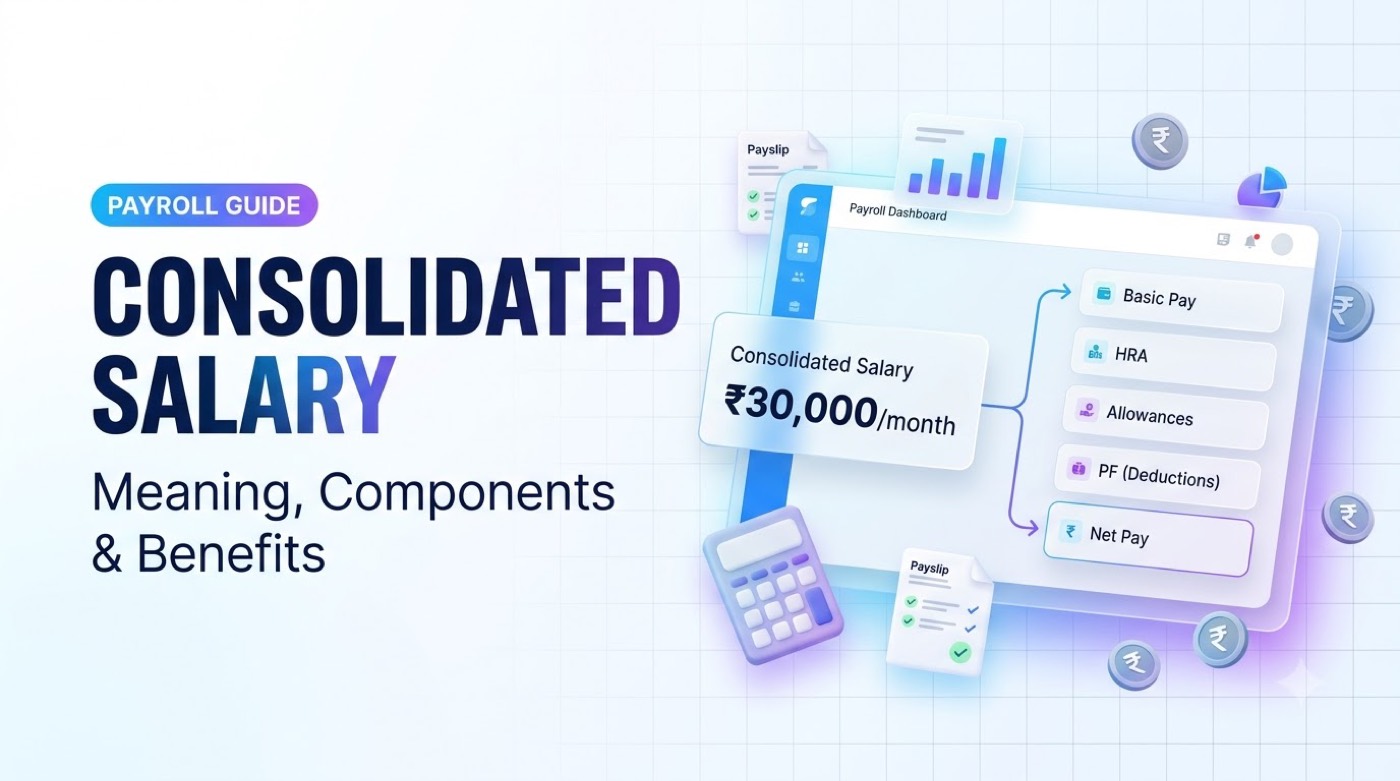
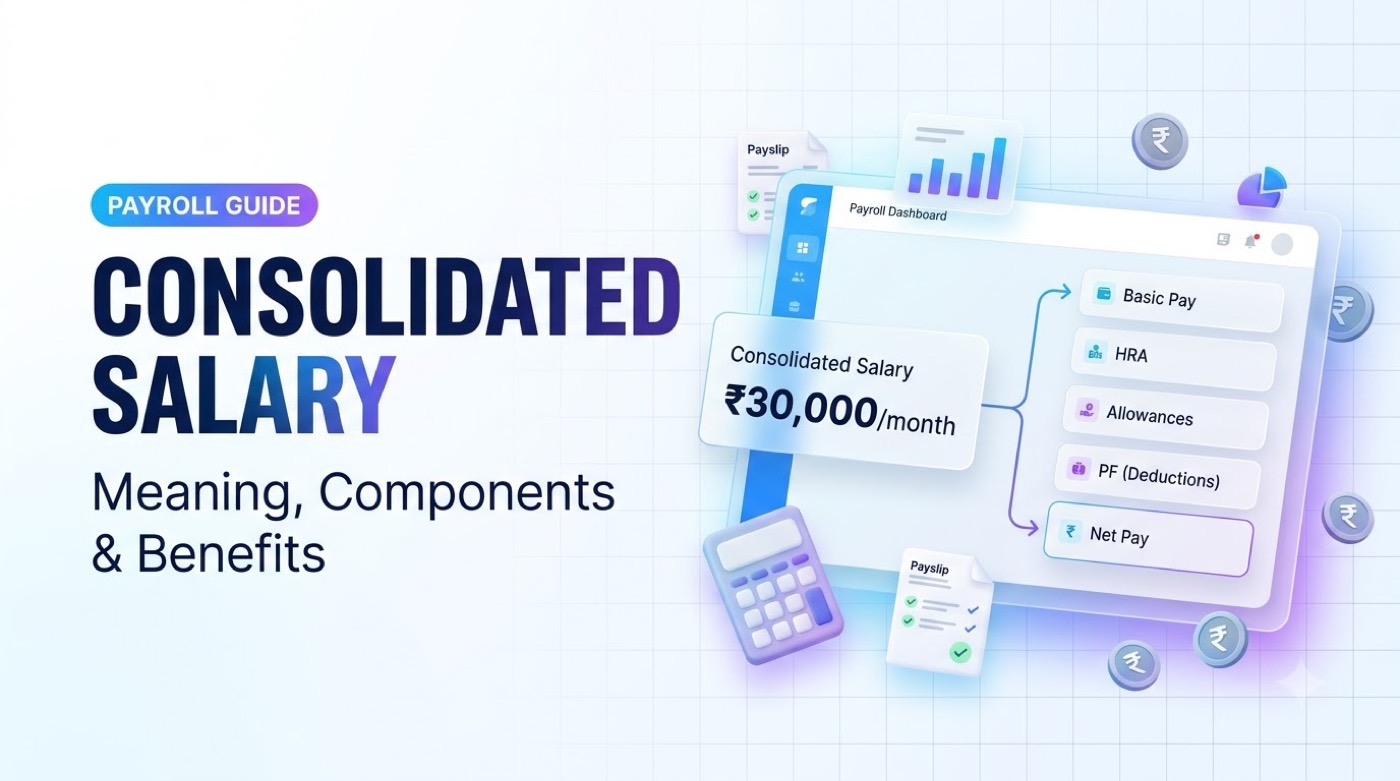
For example, an organization may offer an employee a fixed monthly salary of ₹30,000 without separately specifying how much is allocated to basic salary, HRA, transportation allowance, or other components.
The main objective is to simplify compensation management by reducing the number of separate components used to determine an employee’s salary.
Consolidated salary is commonly used for:
- Contractual employees.
- Temporary and project-based employees.
- Consultants and certain professional engagements.
- Employees working with startups and small businesses.
- Fixed-term or short-duration assignments, where appropriate.
However, agreeing on a consolidated salary does not necessarily relieve an employer of statutory deductions or employee benefit obligations. Employers must comply with all applicable labour laws based on the nature of employment, employee eligibility, and statutory requirements.
How Does Consolidated Salary Work?
An employer and an employee can enter into a consolidated salary arrangement in which they agree on a single, fixed amount of compensation.
Unlike a traditional salary structure, the total amount may be displayed as a single earning component on the employee’s compensation statement.
Let’s understand this with an example.
Suppose a company employs an individual on a total monthly consolidated salary of ₹30,000.
The compensation arrangement may look like this:
| Salary Particulars | Amount |
|---|---|
| Monthly Consolidated Salary | ₹30,000 |
| Yearly Consolidated Salary | ₹3,60,000 |
The employee receives the mutually agreed compensation amount after applicable deductions, as required by law.
For example, when PF and/or ESI deductions are applicable, they must be calculated according to the relevant statutory provisions. Similarly, income tax treatment must be determined based on applicable tax laws.
Therefore, it is incorrect to assume that the consolidated salary offered by an employer is the same as an employee’s actual net pay or take-home salary.
Employers must clearly specify whether the agreed amount represents gross salary, remuneration before statutory deductions, or the total employer cost (CTC). These three terms cannot be used interchangeably.
Key Features of Consolidated Salary
A consolidated salary arrangement differs from a traditional salary structure in several ways.
Fixed Compensation Amount
Employees receive an agreed monthly or annual compensation amount.
This makes it easier for employers to communicate the total compensation offered for a particular position during the hiring process.
Simplified Salary Presentation
Traditional salary packages may include several components, such as basic pay, housing allowance, special allowances, transportation costs, and additional benefits.
A consolidated salary package presents the total compensation as a single amount without providing a detailed breakdown of individual components.
Flexible Compensation Arrangements
Employers can determine employee compensation based on several factors, including the nature of the job, employment duration, project requirements, and overall business needs.
This flexibility can be beneficial when hiring consultants, contractual employees, and professionals on an as-needed basis.
Applicable Statutory Deductions Still Apply
Consolidated salary does not provide an exemption from statutory obligations.
Depending on employee eligibility and applicable laws, deductions may include:
- Provident Fund (PF).
- Employees’ State Insurance (ESI).
- Professional Tax.
- Other applicable statutory deductions.
Tax Treatment Depends on the Nature of Payment
Consolidated salary received as employment remuneration is generally subject to taxation under applicable income tax laws.
The absence of a detailed salary breakup does not automatically make the entire income tax-free. However, eligible exemptions and deductions may still apply depending on the applicable provisions.
Consolidated Salary vs Structured Salary
Consolidated salary and structured salary are two different ways of presenting an employee’s total compensation package.
A consolidated salary provides the employee with a single combined payment, whereas a structured salary divides compensation into different components.
Here is a comparison:
| Comparison Factor | Consolidated Salary | Structured Salary |
|---|---|---|
| Salary Presentation | Single combined amount | Multiple salary components |
| Salary Breakup | Limited or no detailed breakup | Detailed component-wise breakup |
| Payroll Administration | Simpler salary presentation | Requires component-wise calculations |
| Tax Planning | Limited flexibility in allocating salary components | Eligible tax exemptions and benefits may be available |
| Statutory Compliance | Applicable statutory obligations apply | Applicable statutory obligations apply |
| Common Usage | Temporary and contractual roles | Typically used for permanent employees |
| Employee Understanding | Employees can easily identify the agreed total compensation but may need clarification about deductions | Provides greater visibility into earnings and individual deductions |
A single, unified pay structure makes it easier for companies to communicate compensation to employees. Conversely, a formal salary structure allows both employers and employees to understand how each component of the total compensation is allocated.
Tax benefits and regulatory compliance are not automatically guaranteed by either structure. The tax treatment depends on the specific compensation arrangement and applicable laws.
Advantages of Consolidated Salary
Consolidated salary can offer advantages to both organizations and employees when implemented with appropriate compensation guidelines.
Here are some of its major advantages.
Simplifies Payroll Administration
HR and payroll departments generally manage different salary components through separate calculations, earning heads, and applicable rules.
A single consolidated salary arrangement can simplify salary presentation and compensation administration.
This can be particularly helpful for smaller companies with limited HR resources.
Easy to Communicate
Employers can communicate a fixed compensation amount during the hiring process without explaining every individual salary component.
Employees can easily understand the total agreed compensation, making salary discussions between employers and employees simpler.
Flexible Compensation Planning
Organizations can agree on compensation based on the requirements of specific roles, projects, or types of work.
This adaptability is useful for short-term projects, consultants, and professionals working on a project-by-project basis.
Reduces Salary Component Complexity
HR teams can simplify salary administration and communicate compensation changes more easily when fewer individual salary components are displayed.
However, even when payroll is outsourced to a third-party provider, the provider must correctly calculate employee payments, determine applicable statutory deductions, and submit accurate reports.
Useful for Short-Term Engagements
A single payment agreement can make it easier to communicate and manage compensation for short-term and fixed-term positions.
It also provides a straightforward way to document the agreed compensation for such engagements.
Disadvantages of Consolidated Salary
Although consolidated salary offers simplicity, it also has several disadvantages for both employers and employees.
Limited Visibility Into Salary Components
Employees may not clearly understand how their total compensation relates to basic salary, allowances, and other benefits.
This can create confusion when reviewing payslips, statutory contribution reports, and employee benefit information.
Limited Salary Structuring Flexibility
Traditional salary structures contain different components that may receive specific tax treatments under applicable regulations.
A consolidated arrangement can reduce the available options for structuring compensation through eligible allowances and exemptions.
Depending on the applicable tax laws and an employee’s individual tax circumstances, consolidated salary may be more or less tax-efficient.
Potential Confusion About Statutory Benefits
Employees may assume that statutory deductions and benefits, such as PF, ESI, and gratuity, are automatically included in their total salary package if the employment contract does not clearly explain applicable deductions and entitlements.
Employers have a responsibility to communicate employees’ statutory rights and responsibilities.
Complicated Take-Home Salary Calculations
The consolidated salary amount is not necessarily the amount deposited into an employee’s bank account.
Applicable deductions, such as PF, ESI, Professional Tax, and Income Tax, may be subtracted from gross pay to calculate the final take-home salary.
May Not Suit Long-Term Compensation Planning
For full-time employees receiving different benefits, incentives, and salary adjustments, a formal compensation structure may provide greater clarity and make salary administration more efficient.
Is Consolidated Salary Taxable?
Yes. Salary received by an employee as compensation for employment is generally taxable under the applicable income tax laws.
The absence of separate salary components does not make the payment tax-free.
Employers determine the applicable Tax Deducted at Source (TDS) after estimating an employee’s taxable income and calculating deductions according to the relevant tax provisions.
Let’s understand this with an example.
Suppose an employee receives a consolidated salary of ₹40,000 per month.
| Particulars | Amount |
|---|---|
| Consolidated Salary Per Month | ₹40,000 |
| Consolidated Salary Per Year | ₹4,80,000 |
| Deductions as Applicable | As per applicable rules |
| Taxable Income Liability | Based on taxable income and applicable tax regime |
The employee’s final tax liability depends on the applicable tax regime, eligible deductions or exemptions, additional income, and prevailing income tax rules.
Employees should assess their complete tax circumstances rather than automatically assuming that consolidated salary will receive different tax treatment compared to other salary structures.
Does Consolidated Salary Include PF, ESI and Gratuity?
This is one of the most frequently asked questions by both employees and employers regarding consolidated salary.
The answer depends on the nature of employment, applicable employment laws, employee eligibility, and how the compensation is structured.
Provident Fund (PF)
The applicability of Provident Fund is determined under the Employees’ Provident Funds and Miscellaneous Provisions Act, 1952, along with other relevant regulations.
Employers cannot avoid their PF liabilities simply by referring to an employee’s total compensation as consolidated salary.
The applicable wage definition and statutory calculation rules must be followed.
Employees’ State Insurance (ESI)
ESI applicability depends on several factors, including the establishment’s coverage, employee eligibility, and the applicable wage limits.
When the ESI Act applies, employers must calculate and deposit contributions according to the prescribed statutory guidelines.
Gratuity
Gratuity eligibility and payment obligations depend on applicable gratuity laws and the terms of employment.
Where an employee meets the eligibility requirements, an employer cannot simply remove its gratuity obligations by offering a single consolidated salary amount.
Employers must clearly distinguish between a consolidated salary figure and the total cost incurred by the organization for employing an individual.
When Should Companies Use Consolidated Salary?
In certain situations, a consolidated salary arrangement can be useful when an organization prefers a straightforward compensation system.
Contractual Employees
Organizations hiring employees for specific contracts can use a consolidated compensation package to communicate the agreed payment terms.
However, the arrangement must comply with all applicable employment laws and regulatory obligations.
Startups and Small Businesses
Early-stage businesses may prefer simpler compensation arrangements to reduce administrative complexity.
As an organization grows, its HR department should evaluate whether a more formal and comprehensive salary structure is required.
Consultants and Professional Engagements
Consultants and other self-employed professionals may receive compensation based on a fixed agreed rate.
However, the tax and legal treatment of professional fees differs from that of employee salaries.
Project-Based Roles
Consolidated compensation can simplify communication and administration for employees hired for short-term assignments or specific projects.
The appropriate compensation arrangement should depend on the nature of the employment contract rather than simply the amount being paid.
Best Practices for Managing Consolidated Salary
A simple salary structure should not create confusion about employee compensation or leave compliance requirements unaddressed.
HR teams can follow these practices to manage consolidated salary effectively.
Clearly Define the Salary Terms
Clearly specify whether the agreed amount represents gross salary, remuneration before statutory deductions, or the complete Cost to Company (CTC).
Also communicate which deductions and benefits apply.
Maintain Proper Documentation
Include compensation details, payment schedules, applicable deductions, and employment terms in the offer letter or employment agreement.
Ensure Statutory Compliance
Review applicable obligations such as PF, ESI, gratuity, Professional Tax, and other statutory requirements according to the nature of employment and prevailing regulations.
Maintain Accurate Payroll Records
Even when total compensation is presented as a single amount, payroll records must accurately capture:
- Different types of earnings.
- Employee deductions.
- Employer contributions.
- Other required statutory reporting information.
Use Payroll Automation
Manual payroll processing can become increasingly difficult as an organization expands.
An integrated HRMS and payroll system can help businesses manage employee benefits, taxes, salary processing, and payroll documentation in a more organized manner.
Review Compensation Structures Periodically
Organizations should periodically evaluate whether their consolidated salary arrangement remains suitable when employees transition into long-term positions, receive promotions, or take on additional responsibilities.
How Does an HRMS Help Manage Consolidated Salary?
As a business expands, maintaining accurate employee compensation and payroll records becomes increasingly challenging.
Manually calculating employee salaries every month can be time-consuming, while maintaining accurate compensation records becomes more difficult as the workforce grows.
An integrated Human Resource Management System (HRMS) provides a centralized platform for HR and payroll professionals to access employee information, salary details, benefits, and employment records. It also helps organizations manage different employee compensation arrangements more effectively.
ZestNexus helps companies simplify HR and payroll operations through features such as:
- Employee Management: Centralized storage of employee profiles, personal information, employment details, and salary-related records.
- Salary Structure Management: Manage employee compensation components and maintain structured salary information.
- Payroll Processing: Calculate monthly salaries, apply applicable deductions, and manage payroll operations.
- Payslip Generation: Generate and share employee payslips containing detailed earnings and deduction information.
- Payroll Report Maintenance: Access employee-wise compensation information and maintain organized payroll reports.
- Employee Self Service: Allow employees to view applicable payroll information and payslips through an employee self-service portal.
A well-managed payroll process improves compensation accuracy, increases transparency, and makes administration more efficient, whether an organization manages compensation at a consolidated level or through detailed salary structures.
The Future of Consolidated Salary
With the growth of startups, remote working, consulting, and alternative employment arrangements, the way companies design compensation packages continues to evolve.
Businesses increasingly require flexible compensation systems that can accommodate different types of professionals and the unique requirements of individual positions.
The simplicity of consolidated salary can make it a suitable option for certain contractual and project-based employment arrangements.
At the same time, employees are becoming more aware of their statutory benefits, tax implications, and overall compensation.
Organizations need to maintain a balance between flexibility, transparency, and regulatory compliance.
Digital Human Resource Management Systems (HRMS) and payroll platforms make it easier for organizations to manage different compensation arrangements, store and update employee information, and process payroll accurately.
The future is not necessarily about choosing between a structured salary and a consolidated salary. Instead, organizations need to select the most suitable compensation arrangement while ensuring employees understand their earnings and employers fulfil their statutory responsibilities.
Conclusion
Consolidated salary is a compensation arrangement in which employees receive a mutually agreed fixed amount without a detailed breakdown of individual salary components.
It can be useful for startups, contractual employees, consulting engagements, and project-based roles. However, organizations must carefully consider its tax implications, applicable statutory deductions, and employee benefit obligations.
Employers should prioritize transparent compensation communication, accurate payroll records, and compliance with applicable employment laws.
Businesses can use an integrated HRMS and payroll solution like ZestNexus to simplify compensation management, maintain employee records, and automate payroll processes.
Simplify your payroll. Organize employee compensation. Manage your workforce more effectively with ZestNexus.
Frequently Asked Questions
What is consolidated salary in HR?
Consolidated salary in HR refers to a single combined payment made to an employee instead of providing a detailed breakdown of individual salary components, such as basic pay, HRA, and other allowances.
Is consolidated salary taxable in India?
Generally, yes. Consolidated salary received as employee remuneration is subject to applicable income tax provisions. The actual tax liability depends on the employee’s income, applicable tax regime, and eligibility for deductions or exemptions.
Who typically receives consolidated salary?
Contractual employees, temporary employees, consultants, and professionals working on project-based assignments commonly receive consolidated salary. However, the appropriate compensation arrangement depends on the nature of the employer-employee relationship.
What is the difference between consolidated salary and gross salary?
Consolidated salary refers to a combined compensation amount without necessarily providing a detailed component-wise breakup. Gross salary generally represents an employee’s total earnings before employee-side deductions are made and may include separately identified salary components.
Does consolidated salary include PF and ESI?
Employers must fulfil applicable PF and ESI statutory obligations regardless of whether an employee’s compensation is described as consolidated salary. Applicability and contributions depend on the relevant statutory provisions.
Is consolidated salary the same as CTC?
No. Consolidated salary and Cost to Company (CTC) are not necessarily the same. CTC represents the overall annual cost incurred by an employer for an employee, which may include employer contributions and additional benefits. Consolidated salary generally refers to an agreed combined remuneration amount.
Is consolidated salary better than structured salary?
It depends on the employment arrangement and individual requirements. Consolidated salary is simpler to understand, while a structured salary provides greater visibility into individual compensation components and may offer additional options for tax planning, depending on applicable laws.
Can an employer deduct PF from consolidated salary?
Where PF provisions apply, employers must calculate employee contributions according to the applicable statutory wage definition and rules. Paying an employee through a consolidated salary arrangement does not automatically exempt the employer from PF obligations.
Does consolidated salary include gratuity?
Gratuity does not automatically form part of an employee’s consolidated salary. Where an employee is eligible under applicable gratuity laws, the employer must fulfil the relevant statutory obligations.
Can consolidated salary be changed to a structured salary?
Yes. An employer may modify an employee’s compensation structure according to the employment contract, company policies, and applicable laws. Employees must be appropriately informed about changes to their compensation arrangements.
Similar blogs you may like