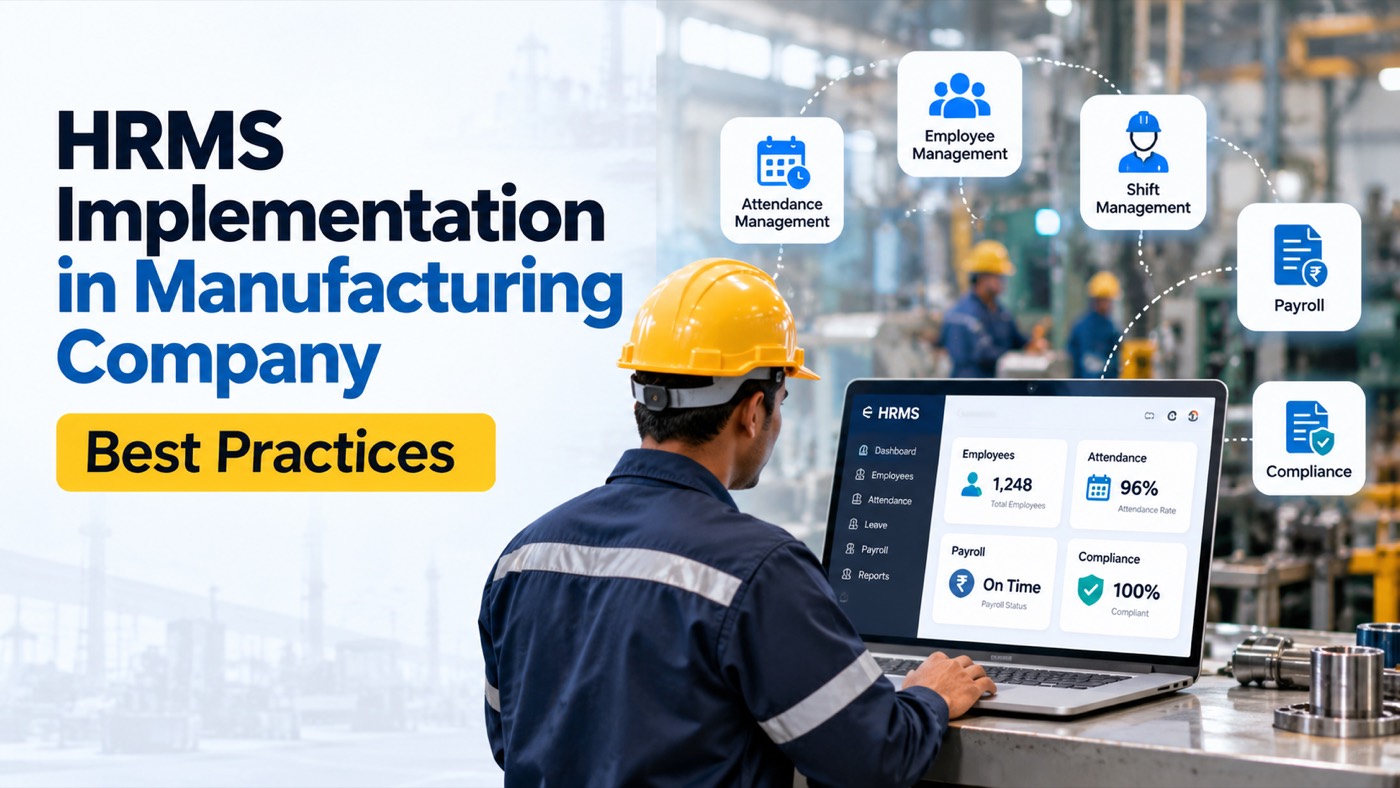
HRMS Implementation in Manufacturing Company: Best Practices
Learn the best practices for HRMS implementation in a manufacturing company, including process mapping, data migration, attendance, shift management, payroll, compliance, employee adoption, and post-implementation monitoring.
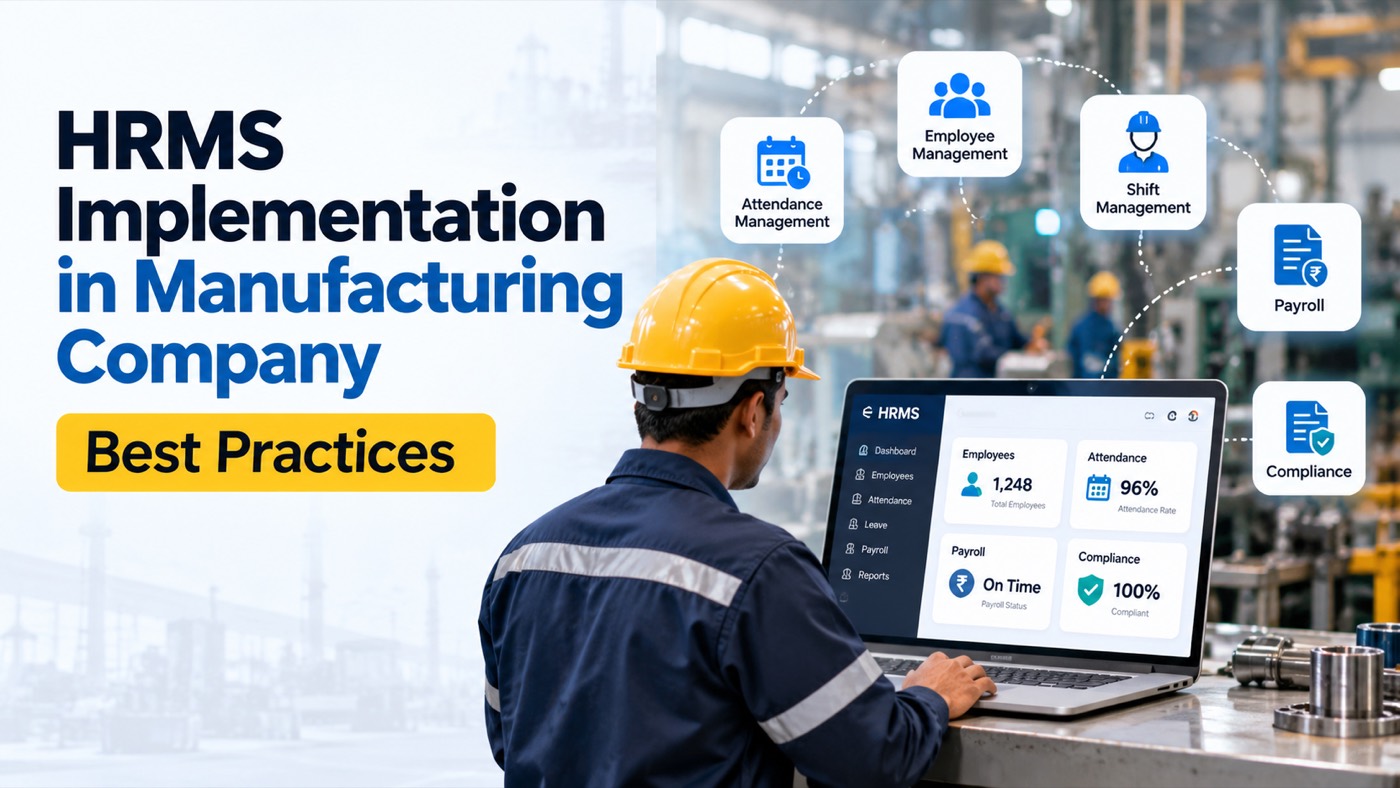
Managing HR operations in a manufacturing company can be much more complicated than managing day-to-day HR activities in an office environment. Time and attendance management needs to account for multiple shifts, factory locations, contract workers, overtime, irregular attendance patterns, leave management, payroll, and statutory compliance.
As the workforce grows, managing these processes through spreadsheets, paper records, or disconnected software can become challenging. This is where an HRMS (Human Resource Management System) can transform workforce management.
However, purchasing HRMS software is not enough. Successful implementation requires proper planning, employee involvement, process mapping, data migration, system configuration, and continuous monitoring.
This guide explains the best practices for HRMS implementation in manufacturing companies and how businesses can move from traditional HR processes to a modern digital workforce management system.
What Is HRMS Implementation?
HRMS implementation is the process of introducing and configuring a Human Resource Management System to manage HR processes digitally within an organization.
Depending on an organization’s requirements, an HRMS may include:
- Employee onboarding and offboarding
- Employee records and documentation
- Attendance management
- Shift and roster management
- Leave and holiday management
- Overtime tracking
- Payroll processing
- PF, ESI, PT, and TDS processes
- Recruitment and applicant tracking
- Performance management
- Expense management
- Employee self-service
- Workforce analytics and reports
For a manufacturing organization, HRMS implementation must also account for shift-based work, factory locations, contract labour, biometric attendance, overtime, production schedules, and statutory compliance.
Why Is HRMS Implementation Important for Manufacturing Companies?
Most manufacturing organizations have employees working across production floors, warehouses, plants, branches, or client locations.
Traditional HR processes can create several operational challenges, including:
- Manual attendance calculations
- Errors in overtime calculations
- Difficulty managing multiple shifts
- Payroll delays
- Duplicate employee records
- Difficulty tracking contract workers
- Compliance-related risks
- Limited visibility into workforce costs
- Time-consuming HR reporting
Lack of Coordination Between HR, Payroll, and Operations
One of the major challenges in manufacturing organizations is the lack of coordination between HR, payroll, and operations.
An HRMS software for manufacturing units can bring these processes together in one centralized system.
Instead of maintaining separate spreadsheets for attendance, employee records, leave, payroll, and reports, HR teams can manage everything through a single platform.
8 Best Practices for HRMS Implementation in Manufacturing
1. Analyze Your Existing HR Processes
Before implementing an HRMS, understand how your existing HR processes work.
The first step toward adopting useful software is identifying how HR activities are currently performed.
Begin by mapping the entire employee lifecycle, from recruitment and onboarding through attendance, payroll, performance management, and exit.
Identify:
- Which processes are manual?
- Where are spreadsheets being used?
- Where do errors frequently occur?
- How is attendance collected?
- How are shifts assigned?
- How is overtime calculated?
- How is payroll processed?
- Which statutory reports are required?
- How are contract workers managed?
- Which reports does management need?
This assessment helps identify exactly what your HRMS implementation needs to solve.
Do not select an HRMS simply because it has a long list of features. Instead, choose functionality based on the actual requirements of your organization.
2. Define Clear HRMS Implementation Goals
Your HRMS implementation should have measurable and clearly defined goals.
A manufacturing company may want to:
- Reduce manual attendance work
- Improve payroll accuracy
- Reduce payroll processing time
- Automate overtime calculations
- Improve shift management
- Centralize employee records
- Improve statutory compliance tracking
- Give employees self-service access
- Reduce dependency on spreadsheets
- Generate real-time HR reports
Defining these objectives before implementation makes it easier to measure the success of the HRMS later.
Example
| Before Implementation | After Implementation |
|---|---|
| Payroll requires five working days | Payroll takes two days to process |
Clear benchmarks provide a practical way to measure the impact of HRMS implementation.
3. Select an HRMS Built for Manufacturing Processes
Not every HRMS is suitable for a manufacturing environment.
Before selecting HRMS software, manufacturing companies should evaluate whether the system can handle their operational requirements.
Important features to consider include:
Shift Management
The HRMS should support:
- Multiple shifts
- Rotational shifts
- Circular shifts
- Night shifts
- Flexible timings
Attendance Management
Depending on the organization’s requirements, manufacturing companies may need:
- Biometric attendance
- Mobile attendance
- Geo-fencing
- IP-based attendance
- Web-based attendance
Overtime Management
The HRMS should provide easy recording, approval, and calculation of overtime according to organizational policies.
Contract Workforce Management
If the organization works with contract labour, the HRMS should provide appropriate employee records, workforce information, and reports.
Payroll Management
The HRMS should connect:
- Attendance
- Leave
- Overtime
- Payroll
- Employee salary structures
Compliance Management
The system should support required statutory processes and reports according to the organization’s requirements.
Workforce Analytics
Management should be able to understand:
- Employee costs
- Attendance patterns
- Overtime
- Unplanned leave
- Workforce KPIs
Selecting an HRMS that understands manufacturing workflows can make implementation much simpler.
4. Start With a Pilot Implementation
Instead of implementing the HRMS across every plant, branch, or division at once, consider starting with a pilot project.
You can select:
- One plant
- One department
- One location
- A representative employee group
Use the pilot to test:
- Employee data
- Attendance
- Shifts
- Leave
- Overtime
- Payroll
- Approvals
- Reports
- Employee self-service
A pilot allows the HR team to identify and resolve problems before rolling the system out across the entire organization.
Once the workflow is stable, the HRMS can be deployed gradually across other locations.
5. Clean and Validate Employee Data Before Migration
Data migration is one of the most important parts of HRMS implementation.
Manufacturing organizations may have years of employee information stored across spreadsheets, payroll systems, and physical records.
Clean the Data Before Importing Into the New HRMS
Check for:
- Duplicate employees
- Incorrect employee IDs
- Missing joining dates
- Incorrect bank information
- Incomplete salary structures
- Incorrect department names
- Missing statutory information
- Inconsistent designations
- Outdated employee records
A clean database provides a strong foundation for the new HR system.
Remember: Garbage in, garbage out.
Even the best HRMS can generate incorrect reports if the underlying employee data is inaccurate.
6. Integrate Attendance With Payroll
In manufacturing, attendance and payroll are closely connected.
Employees may work different shifts, overtime hours, weekly offs, and holidays. Calculating payroll manually from attendance records can therefore become complicated.
A manufacturing HRMS should connect:
Attendance → Leave → LOP → Overtime → Payroll
This integration reduces duplicate data entry and helps minimize payroll errors.
For example, an approved leave can automatically be considered during payroll processing, while approved overtime can be included in salary calculations according to organizational rules.
7. Configure Shifts, Overtime, and Leave Policies Carefully
Workforce policies in manufacturing organizations can be complex.
Before going live, configure:
- Shift timings
- Grace periods
- Late-coming rules
- Early-leaving rules
- Night shifts
- Weekly offs
- Holiday calendars
- Overtime rules
- Comp-off policies
- Leave policies
- Loss of Pay rules
- Attendance regularization
These configurations should be tested against real-world scenarios.
Example Scenario
An employee works overnight, their attendance continues into the next day, they perform overtime that requires approval, and payroll is subsequently calculated.
Such scenarios should be tested before moving into a live environment to reduce the risk of payroll and attendance issues.
8. Involve Employees and Managers Early
HRMS implementation should not be treated only as an IT project. It is also a transformation in people and processes.
Employees and managers should understand:
- What processes will change
- How attendance will work
- How leave will be applied
- How employees can access payslips
- How regularization requests will work
- How managers will approve requests
- How employee information can be accessed
- How to use the system based on their roles
Training should be role-specific.
Employees
Employees should learn how to manage:
- Attendance
- Leave
- Payslips
- Personal information
Managers
Managers should learn how to manage:
- Team attendance
- Approvals
- Workforce reports
- Daily workforce information
HR Teams
HR teams should learn how to manage:
- Employee records
- Payroll
- Compliance
- Analytics
Management
Management should have access to:
- Dashboards
- Employee costs
- Workforce information
- Business-level reports
Automate Wherever Possible
An HRMS should do more than simply digitize documents. Its purpose should also be to reduce repetitive administrative work.
Identify processes that can be automated.
Manual Leave Process
A traditional leave workflow may look like:
Employee → HR → Email → HR checks leave balance → Spreadsheet update → Manager approval → HR updates records
Automated Leave Process
With an HRMS, the workflow can become:
Employee submits leave request → Manager approves → Leave balance updates automatically → HR records update
The same principle can be applied to:
- Attendance regularization
- Payroll workflows
- Employee onboarding
- Employee documentation
- Approvals
- Reports
Automation allows HR teams to spend less time on administrative tasks and more time focusing on workforce strategy.
Monitor the System After Go-Live
HRMS implementation does not end when the software goes live.
The first few months are especially important for monitoring adoption, accuracy, and system performance.
Monitor:
- Attendance accuracy
- Payroll accuracy
- Employee adoption
- Manager approvals
- Data quality
- System usage
- Support requests
- Reporting accuracy
- Compliance processes
Gather feedback from employees, managers, and HR teams.
If the same issue is repeatedly raised by employees, investigate whether it is related to:
- Training
- System configuration
- Existing processes
- User adoption
Continuous improvement helps organizations derive greater value from their HRMS software over time.
Common Mistakes to Avoid During HRMS Implementation
Even when HRMS implementation is a step in the right direction, poor planning can cause implementation challenges.
Implementing Everything at Once
Configuring every module simultaneously can make implementation unnecessarily complicated.
Begin with the processes that have the biggest operational impact and expand gradually.
Ignoring Employee Experience
If employees find the system difficult to use, adoption can remain low.
Choose simple workflows and provide training relevant to each user group.
Migrating Unclean Data
Transferring incorrect or duplicate employee information into the new HRMS can create problems later.
Always clean and validate employee data before migration.
Not Testing Payroll
Payroll should be thoroughly tested before running the first live payroll cycle.
Test different:
- Salary structures
- Leave conditions
- Overtime hours
- Deductions
- Statutory requirements
Treating HRMS as an HR-Only Tool
HRMS data can provide valuable insights to operations and management regarding:
- Workforce costs
- Attendance
- Overtime
- Productivity
The system should therefore provide business-level reporting rather than being limited to HR administration.
HRMS Implementation Checklist for Manufacturing Companies
Use this checklist before going live.
Employee Management
- [ ] Employee master data migrated
- [ ] Employee documents uploaded
- [ ] Departments configured
- [ ] Designations configured
- [ ] Reporting hierarchy configured
Attendance
- [ ] Attendance devices integrated
- [ ] Mobile/web attendance configured where required
- [ ] Geo-fencing configured where required
- [ ] Attendance rules tested
- [ ] Regularization workflow tested
Shift Management
- [ ] Shifts configured
- [ ] Rotational shifts tested
- [ ] Night shifts tested
- [ ] Weekly offs configured
- [ ] Holiday calendar configured
Leave & Overtime
- [ ] Leave policies configured
- [ ] Leave balances verified
- [ ] LOP rules tested
- [ ] Overtime policies configured
- [ ] Comp-off rules configured
Payroll
- [ ] Salary structures configured
- [ ] Payroll components verified
- [ ] Attendance integration tested
- [ ] Overtime integration tested
- [ ] Statutory components configured
- [ ] Payslip format reviewed
Employee Self-Service
- [ ] Employee login tested
- [ ] Leave requests tested
- [ ] Attendance visibility tested
- [ ] Payslip access tested
- [ ] Profile update workflows tested
Reporting
- [ ] Attendance reports tested
- [ ] Payroll reports tested
- [ ] Workforce reports tested
- [ ] Management dashboards reviewed
- [ ] Statutory reports verified
How Long Does It Take to Implement HRMS?
The implementation timeline depends on the size and complexity of the organization.
A manufacturing company with basic HR processes may complete implementation faster than an organization managing complex shifts, contract workers, and multiple plants.
A typical implementation can include:
Requirement analysis
HR process mapping
Data preparation
System configuration
Integration
Testing
Employee training
Pilot rollout
Organization-wide rollout
Post-implementation support
The goal should not be to implement an HRMS as quickly as possible.
Instead, organizations should focus on implementing it correctly and ensuring employees successfully adopt the system.
Benefits of Effective HRMS Implementation in Manufacturing
A well-implemented HRMS can help manufacturing companies achieve:
- More accurate attendance records
- Faster payroll processing
- Better shift management
- Reduced manual HR work
- Improved overtime tracking
- Centralized employee information
- Better employee self-service
- Easier HR reporting
- Improved workforce visibility
- More structured compliance processes
- Better workforce cost analysis
The right implementation approach can help HR teams move from manually maintaining employee records to analyzing workforce data and making better decisions.
How ZestNexus Helps Manufacturing Companies
ZestNexus is an HRMS designed to help organizations manage core HR, attendance, leave, payroll, employee information, and workforce processes from a centralized platform.
For manufacturing organizations, an HRMS can help bring together processes such as:
- Employee management
- Attendance tracking
- Shift management
- Leave management
- Overtime management
- Payroll
- Employee self-service
- Workforce reporting
The objective is to reduce repetitive HR work while providing better visibility into workforce operations.
Final Thoughts
Implementing an HRMS in a manufacturing company goes beyond simply setting up software.
Successful implementation requires:
- Understanding existing HR processes
- Choosing the right technology
- Preparing employee data
- Configuring manufacturing-specific workflows
- Training employees and managers
- Monitoring the system after go-live
A simple principle can guide the implementation:
Understand the process. Simplify the process. Automate the process. Measure the result.
For manufacturers managing multi-shift operations, attendance challenges, overtime, payroll complexity, and workforce compliance, an effective HRMS can become an important part of modern workforce management.
The key is to select an HRMS that fits the way your manufacturing business operates rather than forcing existing processes into a system that does not align with your requirements.
Frequently Asked Questions
What is HRMS implementation?
HRMS implementation is the process of deploying, configuring, and optimizing Human Resource Management System software to manage HR processes digitally, including employee records, payroll, recruitment, performance management, and other HR activities.
Why is HRMS important for manufacturing companies?
Manufacturing companies often manage multiple shifts, several plants, contract workers, overtime, and complex attendance requirements. An HRMS can streamline these processes and reduce manual HR work.
What are the essential features of a manufacturing HRMS?
Key features include:
- Attendance management
- Shift and roster management
- Leave management
- Overtime management
- Payroll
- Employee self-service
- Compliance reporting
- Employee records
- Workforce analytics
How does HRMS improve manufacturing payroll?
An HRMS can connect attendance, leave, loss of pay, and overtime with payroll. This reduces manual calculations and helps improve payroll processing efficiency.
What should companies consider before implementing an HRMS?
Companies should assess:
- Existing HR processes
- Employee count
- Number of locations
- Shift patterns
- Attendance tracking methods
- Payroll requirements
- Compliance requirements
- Required integrations
- Employee adoption
- Reporting requirements
Do employees need training on HRMS?
Yes. HRMS implementation is not only about setting up the software. Employees, managers, HR teams, and management need appropriate training so they can effectively use the system.
SEO Metadata
SEO Title:
HRMS in Manufacturing Companies: Best Practices for Attendance, Shift, Payroll, Overtime & Compliance
URL Slug:
hrms-implementation-manufacturing-company
Primary Keyword:
HRMS implementation in a manufacturing company
Secondary Keywords:
- HRMS for manufacturing companies
- HRMS implementation
- HRMS software for manufacturing
- Manufacturing HR software
- HR management system for manufacturing
- Manufacturing workforce management
- HRMS payroll
- Manufacturing attendance management
- Shift management software
- Employee management software
- HR automation
- Payroll software for manufacturing companies
Recommended Tags:
- hrms
- hrms implementation
- human resource software
- manufacturing hr
- hr software
- payroll
- attendance management
- workforce management
- manufacturing workforce management
- hr automation
- manufacturing support
Similar blogs you may like