What Is Grapevine Communication? Meaning, Types, Examples, Advantages and Disadvantages
Learn what grapevine communication means, its four types, workplace examples, advantages and disadvantages, and how HR teams can manage informal communication effectively.

Communication is one of the key components of workplace success. Organisations have formal channels for sharing information, including emails, meetings, notices, HR announcements, and updates on messaging platforms. However, employees also communicate informally with one another.
This is known as grapevine communication, which refers to the informal flow of information within an organisation.
So, what is grapevine communication, and why should HR teams understand it?
Grapevine communication is unofficial communication among employees that takes place outside the formal organisational structure. It can spread information quickly, strengthen social relationships, and help employees stay aware of their surroundings. However, incomplete or inaccurate information can also create rumours and confusion.
Understanding how grapevine communication works can help HR teams and managers create a workplace where employees feel connected, heard, and informed.
What Is Grapevine Communication?
Grapevine communication is an informal channel through which information spreads from person to person within an organisation.
Unlike formal communication, it does not necessarily follow the organisational hierarchy and often takes place through unofficial channels.
Example: An employee hears from a colleague that the company may introduce a new work-from-office policy. The employee shares this information with another coworker, who then mentions it to someone else.
If management has not officially announced the policy, the discussion is an example of grapevine communication.
In simple terms, grapevine communication is the unofficial channel through which information circulates within an organisation.
It can happen through:
- Casual conversations
- Lunch or coffee breaks
- Team chats
- Personal messaging groups
- Informal meetings
- Social interactions
- Conversations between employees
- Workplace communities
What Is Grapevine Communication Also Called?
Grapevine communication is also known as:
- Informal communication
- Unofficial communication
- Informal workplace communication
- Word-of-mouth communication
- Rumour communication in certain contexts
However, grapevine communication and rumours are not exactly the same.
Grapevine communication refers to the informal channels through which information flows. A rumour is information that has not been verified.
Therefore, grapevine communication can spread both accurate and inaccurate information.
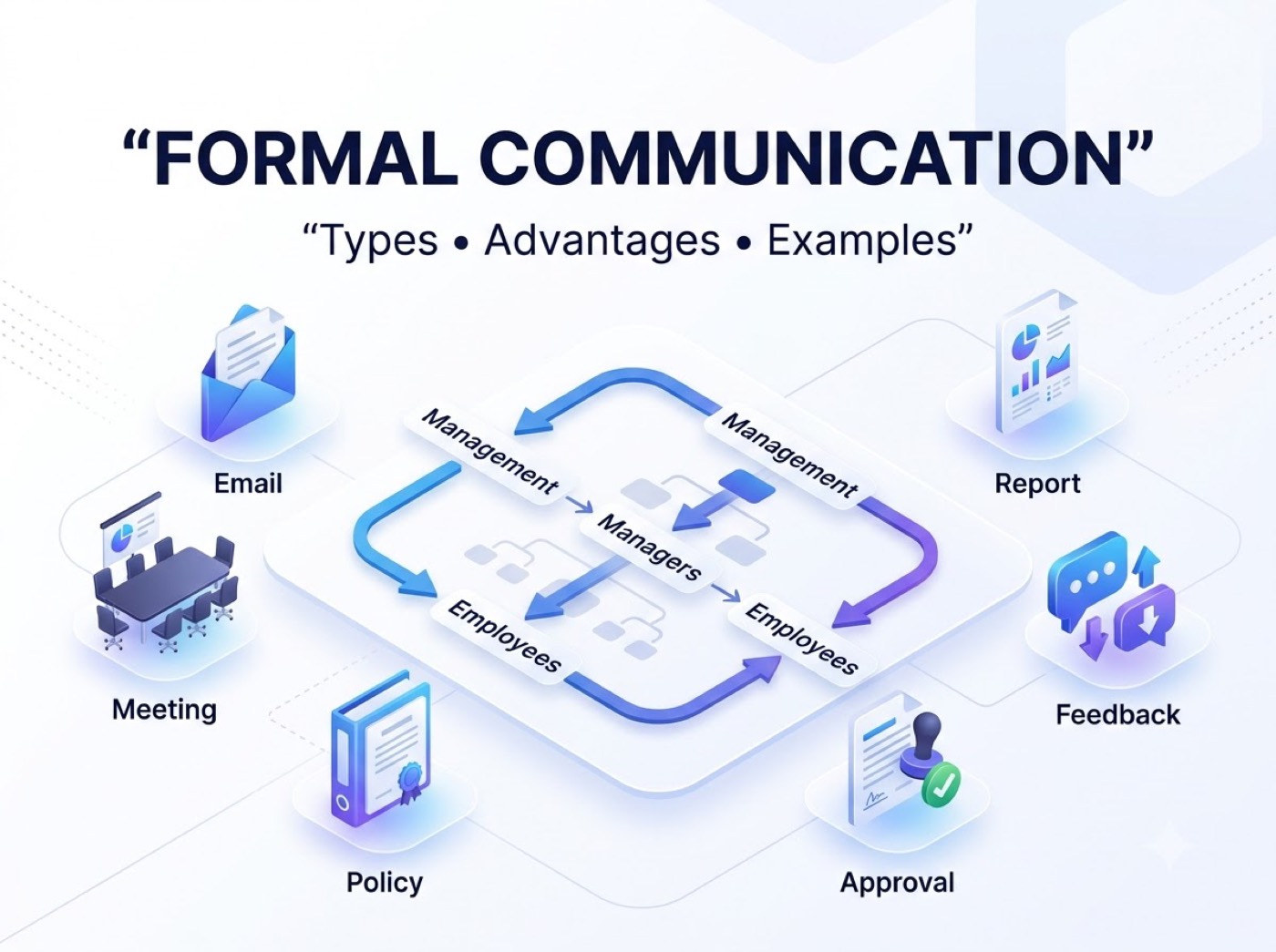
Formal Communication vs. Grapevine Communication
To understand grapevine communication better, it helps to compare it with formal communication.
| Formal Communication | Grapevine Communication |
|---|---|
| Follows established channels | Uses informal channels |
| Usually documented | May not be documented |
| Comes through authorised sources | Can originate from anyone |
| Follows organisational hierarchy | Can move across departments and hierarchical levels |
| More structured | More spontaneous |
| Usually easier to verify | May contain incomplete information |
| Often slower | Can spread very quickly |
Example of formal communication: An official HR email announcing a new leave policy.
Example of grapevine communication: Employees casually discussing a possible change to the leave policy during lunch before an official announcement is made.
Both forms of communication exist in workplaces, but they serve different purposes.
Types of Grapevine Communication
Depending on how information flows between employees, grapevine communication can take four common forms.
1. Single-Strand Chain
In a single-strand chain, one person passes information to another, who then shares it with someone else.
Communication flow:
A → B → C → D
For example, one employee hears about a possible change in office timings and shares the information with a colleague. That colleague passes it to another employee.
This is generally one of the slower grapevine communication patterns. The information may also change as it moves from person to person.
2. Gossip Chain
A gossip chain occurs when one person shares information with several people directly.
Communication flow:
A → B, C, D, E
For example, an employee hears about a potential team restructuring and shares the information with several colleagues.
This pattern can spread information rapidly within a group or social circle.
3. Probability Chain
In a probability chain, information is passed from one person to another on a random basis.
An employee may share information with someone they happen to interact with. That person then passes it to another colleague, and the process continues.
The communication path is unpredictable because there is no fixed sequence of people involved.
4. Cluster Chain
In a cluster chain, one person shares information with a selected group of people, and some members of that group pass it on to others.
Example communication flow:
A → B and C
B → D and E
C → F and G
This creates several interconnected communication paths.
Cluster-chain communication is common in workplaces because employees often share information with colleagues they trust or interact with regularly.
How Does Grapevine Communication Work?
Grapevine communication develops naturally through workplace interactions.
A typical process looks like this:
- An employee hears information about a workplace development.
- The employee discusses it informally with colleagues.
- Those colleagues share the information with others.
- Different employees interpret the information in their own ways.
- The information continues to spread.
- The original message may become outdated, incomplete, or distorted.
Digital communication has increased the speed of this process.
Employees can now share workplace information in real time through:
- WhatsApp groups
- Slack channels
- Google Chat
- Internal messaging tools
- Social networks
- Informal employee communities
These channels help employees stay connected, but they can also make unverified information spread quickly.
Examples of Grapevine Communication in the Workplace
Workplace examples make grapevine communication easier to understand.
Example 1: New Office Policy
An employee hears that the company may revise its work-from-office policy.
Before management makes an official announcement, the employee discusses the possibility with colleagues.
This informal discussion is grapevine communication.
Example 2: Promotion Rumour
Employees begin discussing whether a colleague might be promoted to a leadership position.
Until the information is officially confirmed, the discussion remains unverified.
Example 3: New Employee Benefits
An employee hears from a coworker that the organisation may introduce a new health or wellness benefit.
The information is then shared with other employees through informal conversations.
Example 4: Organisational Changes
Employees notice that managers are holding several meetings and begin speculating about a possible restructuring.
The resulting informal conversations are another example of grapevine communication.
Advantages of Grapevine Communication
Grapevine communication is not necessarily harmful. When understood in the context of workplace relationships, it can offer several benefits.
1. Faster Information Sharing
Information often spreads more quickly through informal conversations than through formal communication channels.
Employees can discuss workplace developments without waiting for an official email or meeting.
2. Builds Social Relationships
Casual workplace conversations help employees connect with their coworkers.
These relationships can strengthen teamwork, collaboration, and workplace culture.
3. Encourages Employee Interaction
Employees may feel more comfortable discussing certain topics informally before raising them through formal channels.
These interactions can encourage collaboration between individuals and teams.
4. Helps Managers Understand Employee Sentiment
Grapevine communication can provide insight into how employees feel about workplace changes.
For example, frequent informal discussions about workload may indicate an underlying concern.
However, managers should not treat rumours as confirmed employee feedback. They should validate concerns through appropriate HR mechanisms, such as surveys, feedback systems, and one-to-one conversations.
5. Supports Workplace Connectivity
Employees naturally exchange information about projects, processes, events, and workplace experiences.
These informal interactions can help employees feel more connected to the organisation.
Disadvantages of Grapevine Communication
Although grapevine communication has benefits, it can also create problems when information is inaccurate, incomplete, or misleading.
1. Spreads Rumours
Unverified information can quickly be accepted as fact.
This may create anxiety, uncertainty, and discomfort among employees.
2. Information Can Become Distorted
When information passes from one person to another, details may be misunderstood or changed.
As a result, the final message may differ significantly from the original information.
3. Can Reduce Employee Trust
When employees receive conflicting messages, they may lose confidence in management’s communication.
A lack of clear official information can make this problem worse.
4. Can Create Workplace Conflict
Misunderstandings and incomplete information can lead to disagreements between employees, managers, and departments.
5. May Affect Productivity
Employees who spend excessive time discussing unverified information may become distracted from their actual responsibilities.
6. Can Damage Workplace Culture
Continuous gossip about layoffs, promotions, salaries, or management decisions can create a negative workplace environment.
Organisations should address misinformation while maintaining open and respectful communication.
What Type of Communication Is Not Grapevine Communication?
A common question is: Which of the following is not an example of grapevine communication?
An official, authorised, and structured communication channel is generally considered formal communication rather than grapevine communication.
Examples include:
- Official HR circulars
- Company-wide policy announcements
- Formal emails from management
- Official employee handbooks
- Authorised organisational notices
These channels communicate information through established organisational processes.
In contrast, an informal discussion among employees about a company decision that has not been officially announced is generally an example of grapevine communication.
Quick Exam Tip
When answering a question about which communication method is not grapevine communication, look for an official or structured channel, such as a formal management email or an authorised company notice.
Grapevine Communication vs. Rumours
Grapevine communication and rumours are often used interchangeably, but there is an important difference.
- Grapevine communication: The informal network through which information spreads.
- Rumour: Information that is unverified or has not been confirmed.
A rumour may spread through the grapevine, but not every instance of grapevine communication involves a rumour.
Employees can also share accurate information through informal conversations.
Grapevine Communication in HR Management
Grapevine communication is important for HR teams because it can influence employee engagement, workplace relationships, and organisational culture.
Employees often discuss topics such as:
- Workload
- Management decisions
- Compensation
- Promotions
- Workplace policies
- Team relationships
- Employee benefits
- Organisational changes
- Company culture
When official communication is unclear or delayed, employees may rely more heavily on informal channels to understand what is happening.
This is why HR teams should prioritise clear, timely, and transparent communication.
Managing Grapevine Communication: The HR Approach
HR teams should not attempt to eliminate every informal conversation among employees. Informal communication is a natural part of workplace relationships.
Instead, organisations should strengthen official communication and reduce the conditions that allow harmful rumours to spread.
1. Communicate Important Changes Quickly
When employees are waiting for information, speculation can fill the gap.
Communicating important decisions clearly and promptly can reduce unnecessary confusion.
2. Create Open Communication Channels
Employees should have appropriate channels to ask questions, share feedback, and raise concerns.
These channels may include:
- HR helpdesks
- Employee feedback systems
- Surveys
- One-to-one meetings
- Town halls
- Internal communication platforms
Accessible communication channels help employees obtain reliable information from appropriate sources.
3. Encourage Managers to Communicate Clearly
Managers are often among the first people employees approach when they hear something through the grapevine.
Ensuring managers receive accurate and timely information helps them answer questions consistently and reduce uncertainty.
4. Address Misinformation
HR teams should clarify incorrect information when it could affect employees or create unnecessary concern.
Ignoring a widely circulated rumour may allow it to spread further.
Timely clarification helps employees distinguish verified information from speculation.
5. Build Trust
A workplace built on trust between employees and management is less likely to experience widespread uncertainty whenever informal information circulates.
Trust develops through regular communication, honest disclosure, and responsible organisational practices.
How HR Technology Can Improve Workplace Communication
Technology can help organisations improve communication and employee engagement processes.
A modern Human Resource Management System (HRMS) can consolidate employee information, HR processes, announcements, documents, attendance, leave, payroll, feedback, and other workforce activities.
ZestNexus brings multiple HR processes together on a single platform, helping employees and HR teams access relevant information and manage routine HR activities more efficiently.
Centralising important employee information can reduce reliance on disconnected spreadsheets, scattered emails, and manual processes.
Technology should not aim to eliminate grapevine communication. Instead, the goal is to ensure that employees have access to clear, accurate, and timely official information so that informal conversations do not become their primary source for important workplace decisions.
6 Ways to Mitigate the Harmful Effects of Gossip
Organisations can take practical steps to reduce the negative effects of workplace gossip and misinformation.
- Maintain transparent workplace communication.
- Share significant announcements through official channels.
- Encourage employees to ask questions.
- Train managers in effective communication.
- Address misinformation promptly.
- Conduct regular employee feedback surveys.
- Create clear HR policies.
- Ensure policies are easily accessible to employees.
- Build a culture where employees feel encouraged to speak up.
- Centralise important employee information using HR technology.
These measures can help organisations create a more informed, connected, and trusting workplace.
Frequently Asked Questions
What is grapevine communication?
Grapevine communication is the informal and unofficial exchange of information among people within an organisation. It does not have to follow the company’s formal hierarchy or established communication channels.
What is grapevine communication known as?
Grapevine communication is also known as informal communication, unofficial communication, or word-of-mouth communication.
Is grapevine communication always negative?
No. Grapevine communication can help employees build relationships, share information quickly, and understand workplace sentiment. It becomes problematic when false information, harmful gossip, or unverified rumours create confusion.
Which of the following cannot be grapevine communication?
An official HR announcement, formal company email, authorised policy circular, or other structured management communication is generally considered formal communication rather than grapevine communication.
What are the types of grapevine communication?
The four commonly discussed types are:
- Single-strand chain
- Gossip chain
- Probability chain
- Cluster chain
Each type describes a different pattern through which information spreads informally.
Why is grapevine communication important from an HR perspective?
Grapevine communication can influence employee relationships, workplace culture, engagement, and perceptions of management. Understanding these informal networks can help HR teams identify communication gaps and address misinformation.
How is grapevine communication different from formal communication?
Formal communication follows established organisational channels and is generally more structured. Grapevine communication occurs informally between employees and can cross departmental and hierarchical boundaries without following a fixed process.
Conclusion
So, what is grapevine communication?
Simply put, grapevine communication is the informal transmission of information among people associated with an organisation. Workplace conversations are a natural part of human interaction and can be both helpful and challenging.
The real question is not whether grapevine communication exists, but how HR teams and business leaders can ensure that employees have access to clear, timely, accurate, and transparent official information.
By improving communication practices and combining them with modern HR technology, organisations can reduce confusion, strengthen trust, and create a more connected employee experience.
ZestNexus brings essential HR processes together on one platform, including employee management, attendance and leave, payroll, recruitment, performance management, and expenses. This helps HR teams reduce repetitive administrative work and spend more time focusing on people.
Disclaimer: This article is for educational and informational purposes only. Workplace communication practices may vary depending on organisational policies, industry requirements, and applicable employment laws.
Similar blogs you may like