Key Result Areas vs Key Performance Indicators: Complete Guide for HR Teams
Learn the difference between Key Result Areas (KRAs) and Key Performance Indicators (KPIs), their role in performance management, performance appraisals, and how HRMS software streamlines performance tracking.
Key Result Areas vs Key Performance Indicators: Complete Guide for HR Teams
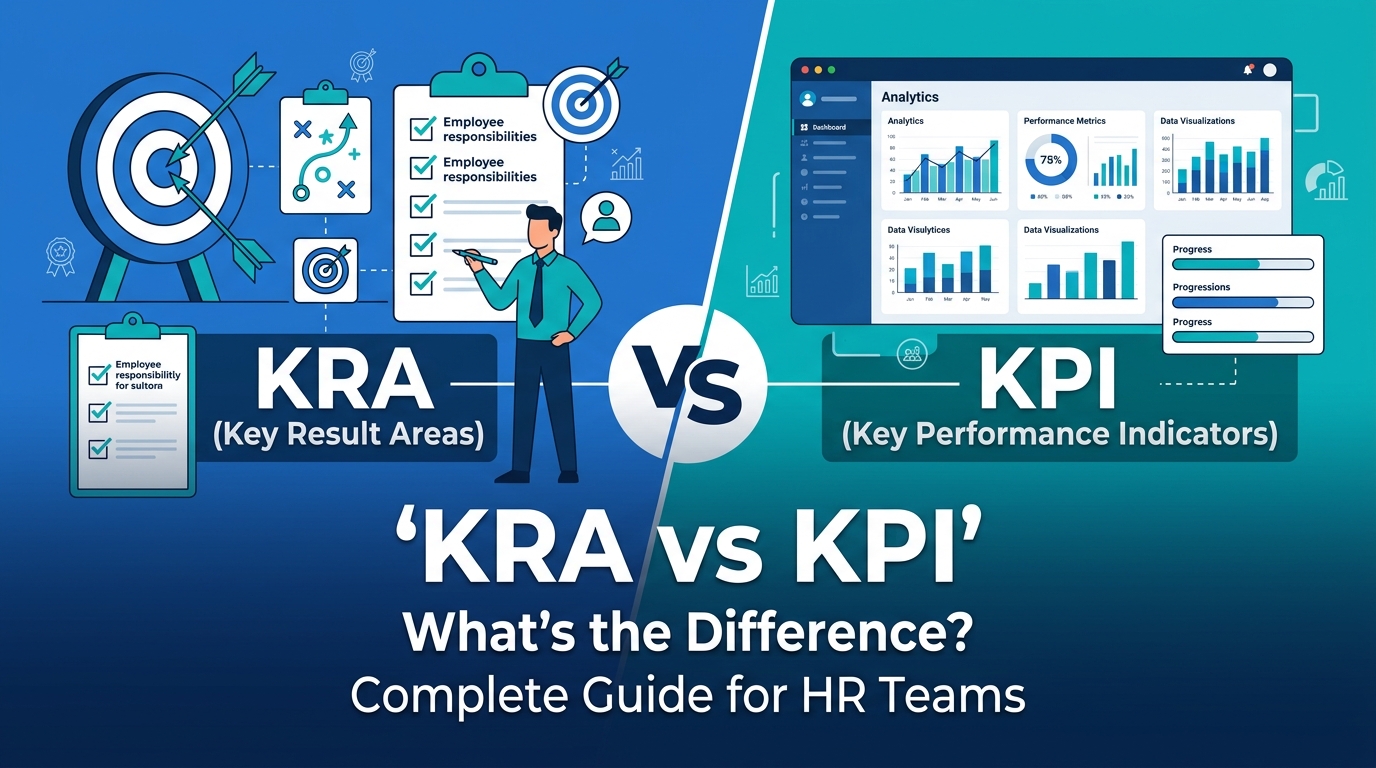
Performance management is essential for aligning employee efforts with business objectives. However, many organizations struggle to understand the difference between key result areas and key performance indicators.
While both KRAs and KPIs are critical components of performance management, they serve different purposes. Understanding these differences helps HR professionals, managers, and business leaders create effective appraisal systems that drive accountability and performance.
In this guide, we’ll explore:
- What KRAs and KPIs are
- Their key differences
- The role of key performance areas in appraisals
- Best practices for implementation
- How HRMS software like ZestNexus simplifies performance management
What Are Key Result Areas (KRAs)?
Key Result Areas (KRAs) refer to the major responsibilities and outcomes associated with a particular role. They define what employees are expected to achieve in order to contribute to organizational success.
In simple terms, KRAs outline the critical functions of a job and establish expectations regarding performance.
Key Characteristics of KRAs
- Focus on responsibilities and outcomes
- Define broad performance expectations
- Role-specific in nature
- Created at the start of a performance cycle
- Align individual goals with organizational objectives
Examples of KRAs
HR Manager
- Talent Acquisition
- Employee Engagement
- Performance Management
- Employee Retention
Sales Executive
- Revenue Generation
- Customer Acquisition
- Account Management
- Client Relationship Building
Customer Support Executive
- Customer Satisfaction
- Issue Resolution
- Ticket Management
- Service Quality Improvement
KRAs form the foundation of key result areas in performance management by helping employees focus on their most important responsibilities.
Understanding KPIs (Key Performance Indicators)
Key Performance Indicators (KPIs) are measurable metrics used to evaluate performance within a KRA.
While KRAs define what should be achieved, KPIs determine how success will be measured.
KPIs provide objective, data-driven insights into employee performance.
Key Characteristics of KPIs
- Specific and measurable
- Data-driven
- Performance-focused
- Time-bound
- Easy to monitor and evaluate
Examples of KPIs
HR Manager
KRA: Talent Acquisition
KPIs:
- Time-to-hire below 30 days
- Offer acceptance rate above 90%
- Cost-per-hire reduced by 15%
Sales Executive
KRA: Revenue Generation
KPIs:
- Achieve ₹10 lakh monthly sales target
- Maintain conversion rate above 20%
- Acquire 50 new clients per month
Customer Support Executive
KRA: Customer Satisfaction
KPIs:
- Customer Satisfaction Score above 95%
- First response time below target
- Ticket resolution within 24 hours
KPIs make it possible to objectively assess whether employees are successfully delivering on their KRAs.
Understanding Key Performance Areas (KPAs)
Many organizations use Key Performance Areas (KPAs) and KRAs interchangeably.
Key Performance Areas represent broad functional areas where employees are expected to perform effectively.
Examples of Key Performance Areas
Marketing Manager
- Brand Awareness
- Lead Generation
- Campaign Management
- Customer Engagement
HR Teams
- Recruitment Effectiveness
- Employee Retention
- Learning & Development
- Workforce Productivity
Although terminology may vary across organizations, key performance areas and KRAs generally serve similar purposes by defining expected outcomes and responsibilities.
Key Result Areas vs Key Performance Indicators
One of the most common HR questions is:
What is the difference between key result areas and key performance indicators?
The answer lies in their purpose.
| Aspect | KRAs | KPIs |
|---|---|---|
| Definition | Broad areas of responsibility | Measurable metrics used to evaluate performance |
| Focus | What needs to be achieved | How achievement is measured |
| Nature | Qualitative | Quantitative |
| Scope | Broad and strategic | Specific and operational |
| Purpose | Defines expected outcomes | Tracks progress and success |
| Measurement | Difficult to measure directly | Easily measurable |
Examples
| KRA | KPI |
|---|---|
| Employee Retention | Retention Rate above 90% |
| Customer Satisfaction | CSAT Score above 95% |
| Revenue Growth | Increase sales by 20% |
Simple Explanation
- KRAs define the destination.
- KPIs measure the journey.
Together, they create a strong performance management framework.
Relationship Between KRAs and KPIs
Although KRAs and KPIs are different, they are closely connected.
Organizations typically define KRAs first and then establish KPIs to measure success within those responsibility areas.
Example
KRA: Employee Engagement
KPIs:
- Employee satisfaction score above 85%
- Participation rate above 75%
- Attrition reduction by 10%
KRA: Training & Development
KPIs:
- Training completion rate above 95%
- Skill improvement score above 80%
- Certification completion percentage
Without KPIs, KRAs remain difficult to measure. Without KRAs, KPIs lack strategic direction.
Both are essential for effective performance management.
Importance of KRAs in Performance Management
1. Clarifies Expectations
Employees clearly understand what is expected from their role.
2. Aligns Individual Goals with Business Objectives
KRAs connect employee contributions directly to organizational goals.
3. Improves Accountability
Employees become responsible for delivering specific outcomes.
4. Enhances Focus
Teams concentrate on high-priority responsibilities.
5. Supports Performance Appraisals
KRAs provide a framework for objective evaluations.
Importance of KPIs in Performance Management
Enables Objective Evaluation
Performance can be assessed using measurable data instead of assumptions.
Supports Continuous Monitoring
Organizations can track progress throughout the year.
Identifies Improvement Areas
Performance gaps become easier to identify and address.
Drives Employee Motivation
Employees understand what success looks like.
Facilitates Data-Driven Decisions
Managers can make informed decisions about promotions, rewards, and development plans.
Key Performance Areas in Performance Appraisal
Clear key performance areas in performance appraisal help create fair and transparent evaluation systems.
How KPAs Support Appraisals
- Define evaluation criteria
- Improve transparency
- Reduce bias
- Support development planning
- Enhance employee engagement
Best Practices for Defining KRAs and KPIs
Step 1: Understand the Role
Identify:
- Key responsibilities
- Expected outcomes
- Areas that create maximum value
Step 2: Define KRAs
Create 4–6 KRAs for each role.
Examples:
- Sales Growth
- Customer Satisfaction
- Employee Development
- Operational Efficiency
Step 3: Create Measurable KPIs
KRA: Customer Satisfaction
KPIs:
- Net Promoter Score above 70
- Customer complaints resolved within 24 hours
- Customer retention rate above 90%
Step 4: Set Realistic Targets
Targets should be challenging yet achievable.
Step 5: Review Regularly
KRAs and KPIs should evolve with changing business priorities.
Common Mistakes Organizations Make
- Setting too many KRAs
- Using vague KPIs
- Ignoring employee input
- Focusing only on numbers
- Failing to track progress
Performance management should be continuous rather than annual.
How HRMS Software Simplifies KRA and KPI Management
Managing KRAs and KPIs manually through spreadsheets is time-consuming and error-prone.
Modern HRMS platforms automate the entire process.
Features
- Digital goal setting
- Real-time performance tracking
- Continuous feedback
- Automated appraisals
- Performance analytics and reporting
Why Choose ZestNexus for Performance Management?
ZestNexus helps organizations build high-performing teams through structured performance management.
With ZestNexus, businesses can:
- Define role-specific KRAs
- Track KPIs in real time
- Conduct structured performance reviews
- Enable continuous feedback
- Set SMART goals
- Generate performance analytics reports
- Improve accountability
- Align workforce performance with business objectives
By automating performance management, ZestNexus helps HR teams create a transparent, data-driven culture.
Conclusion
Understanding the difference between key result areas and key performance indicators is essential for building an effective performance management system.
While key result areas in performance management define employee responsibilities and expected outcomes, KPIs provide measurable metrics to evaluate success.
Similarly, key performance areas identify critical responsibility zones, while key performance areas in performance appraisal ensure fair and objective employee evaluations.
Organizations that effectively combine KRAs, KPAs, and KPIs achieve greater clarity, accountability, alignment, and productivity.
With a modern HRMS solution like ZestNexus, performance management becomes streamlined, transparent, and growth-focused.
Frequently Asked Questions
What is the difference between KRA and KPI?
A KRA defines an employee’s responsibility area, while a KPI measures performance within that responsibility area.
Do organizations need both KRAs and KPIs?
Yes. KRAs provide direction, while KPIs measure progress and results.
What are key performance areas?
Key Performance Areas (KPAs) are broad functional areas where employees are expected to deliver results.
How many KRAs should an employee have?
Most organizations recommend 4–6 KRAs per role to maintain focus and clarity.
Why use HRMS software for managing KRAs and KPIs?
HRMS software automates goal setting, performance tracking, feedback, appraisals, and reporting, making performance management more efficient and data-driven.
Similar blogs you may like