Performance Appraisal Techniques: Traditional and Modern Methods in HRM
Learn about traditional and modern performance appraisal techniques in HRM, their advantages, limitations, and how businesses can choose the right performance management approach.
Performance Appraisal Techniques: Traditional and Modern Methods in HRM
Introduction
Performance appraisal is a major area of Human Resource Management. It enables organizations to assess employee performance, optimize strengths, identify skill gaps, increase productivity, and align personal goals with broader business objectives.
The bigger problem, however, is this: many organizations still perform appraisals as a yearly ritual.
That approach is weak.
A performance appraisal system should not only be an annual rating exercise. It should guide managers in making informed decisions about promotions, training, compensation, succession planning, and employee development.
This is precisely why mastering performance appraisal techniques is crucial for every growing organization.
In this guide, we’ll discuss traditional and modern performance appraisal techniques in HRM, their advantages, limitations, and how businesses can select the most suitable approach.
What Is Performance Appraisal?
Performance appraisal is a systematic process of evaluating an employee’s performance, skills, behavior, and contribution to the organization.
It helps answer critical questions such as:
- Is the employee meeting expectations?
- What are the employee’s strengths?
- Which areas require improvement?
- Is the employee ready for promotion?
- What additional training or development support is needed?
- How well is the employee aligned with business objectives?
A good appraisal system creates clarity. Employees understand expectations, managers gain objective evaluation criteria, and organizations make better workforce decisions.
Importance of Performance Appraisal Techniques
Performance appraisal techniques provide structure to employee evaluations. Without a structured framework, reviews can become subjective, inconsistent, and unfair.
The right appraisal technique helps organizations:
- Provide constructive feedback
- Recognize high performers
- Identify training requirements
- Improve employee engagement
- Support promotion and compensation decisions
- Reduce performance gaps
- Align employee goals with business objectives
- Create a culture of accountability
Performance appraisal is not merely an HR activity. It serves as a strategic tool for workforce optimization.
Types of Performance Appraisal Techniques
Performance appraisal techniques are broadly categorized into:
- Traditional Techniques of Performance Appraisal
- Modern Techniques of Performance Appraisal
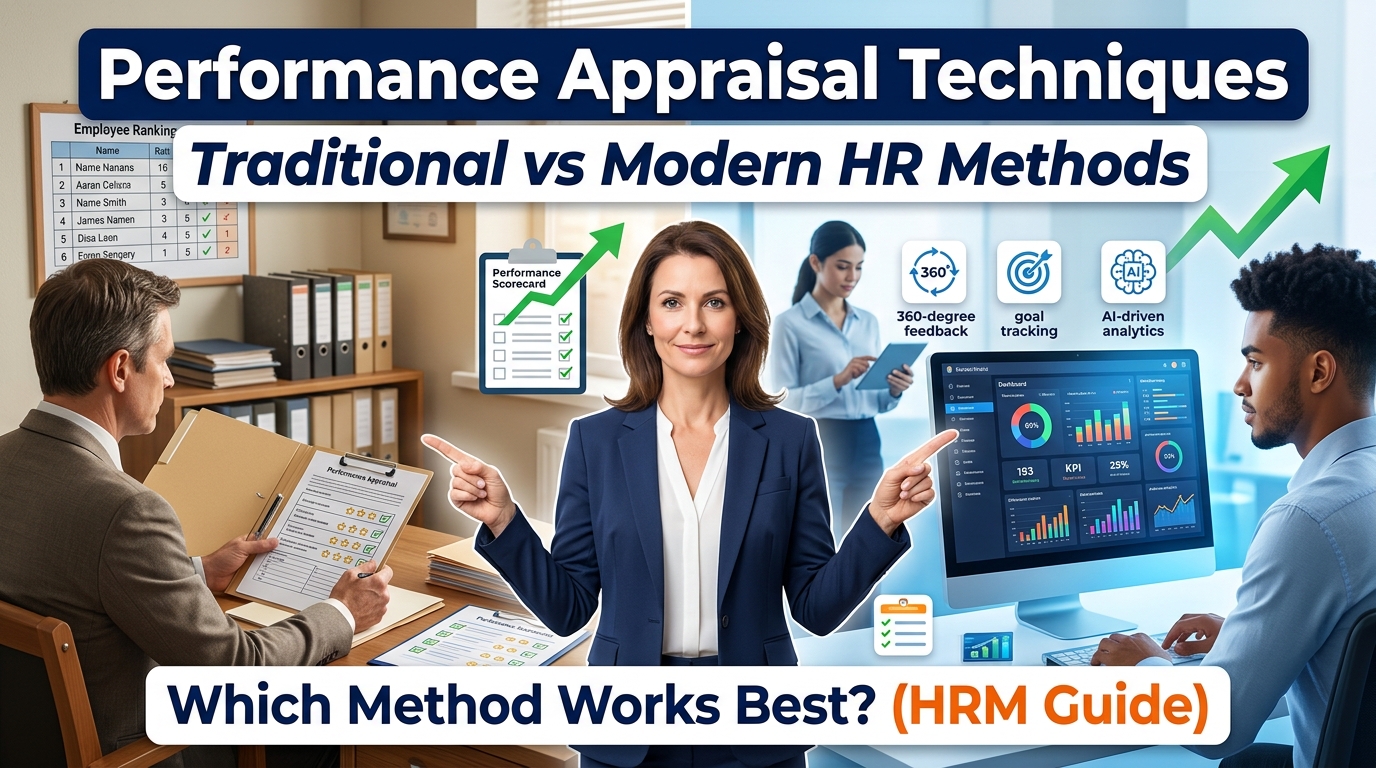
Traditional methods primarily focus on ranking, rating, and comparison. Modern methods emphasize measurable outcomes, competencies, development, and business impact.
Traditional Techniques of Performance Appraisal
Traditional appraisal methods have long been used to evaluate employee performance. While simple and easy to implement, they often involve subjectivity.
1. Ranking Method
The ranking method is one of the simplest performance appraisal techniques.
Employees are ranked from best to worst based on overall performance.
Advantages
- Easy to understand
- Simple to apply
- Useful for small teams
- Helps identify top and low performers
Limitations
- Not suitable for large teams
- Does not capture performance differences accurately
- Can create unhealthy competition
- Susceptible to manager bias
2. Paired Comparison Method
Under this method, each employee is compared with every other employee in the same group.
The employee performing better in each comparison receives a score.
Advantages
- More systematic than ranking
- Useful for employees in similar roles
- Reduces vague assessments
Limitations
- Time-consuming
- Difficult with large teams
- Still depends heavily on evaluator judgment
3. Grading Method
Employees are categorized into predefined performance levels such as:
- Excellent
- Good
- Average
- Below Average
- Poor
Advantages
- Easy to implement
- Creates broad performance categories
- Works well with structured appraisal systems
Limitations
- Too generalized
- Limited detailed feedback
- Managers may overuse middle ratings
4. Graphic Rating Scale Method
The Graphic Rating Scale is among the most widely used performance appraisal methods.
Employees are rated on factors such as:
- Quality of work
- Communication skills
- Teamwork
- Technical expertise
- Leadership
- Dependability
Ratings are typically assigned on scales such as 1–5 or 1–10.
Advantages
- Easy to use
- Evaluates multiple competencies
- Produces measurable scores
Limitations
- Rating bias may occur
- Criteria may lack clarity
- Managers often avoid extreme ratings
5. Checklist Method
Managers respond with “Yes” or “No” against predefined statements regarding employee behavior and performance.
Examples
- Completes work on time
- Collaborates effectively
- Follows company policies
- Takes ownership of responsibilities
Advantages
- Simple and structured
- Easy to standardize
- Reduces evaluator effort
Limitations
- Limited performance context
- Requires role-specific checklists
- Can become mechanical
6. Critical Incident Method
Managers document significant positive or negative employee behaviors throughout the appraisal period.
Advantages
- Based on actual events
- Provides specific examples
- Supports developmental feedback
Limitations
- Requires consistent documentation
- Recent events may receive more attention
- Negative incidents may be recorded more frequently
7. Essay Appraisal Method
Managers prepare a detailed written assessment covering:
- Strengths
- Weaknesses
- Accomplishments
- Behavior
- Growth potential
- Areas of improvement
Advantages
- Rich qualitative feedback
- Captures context effectively
- Useful for developmental discussions
Limitations
- Highly subjective
- Difficult to compare employees
- Time-intensive
Modern Techniques of Performance Appraisal
Modern appraisal techniques focus on measurable outcomes, employee development, competencies, and business impact.
1. Management by Objectives (MBO)
Management by Objectives is one of the most effective contemporary performance appraisal techniques.
Managers and employees jointly establish SMART goals:
- Specific
- Measurable
- Achievable
- Relevant
- Time-bound
Performance is evaluated based on achievement of these goals.
Advantages
- Clear goal alignment
- Objective evaluation
- Encourages employee participation
- Makes performance measurable
Limitations
- Not ideal for all roles
- Poor goal-setting affects outcomes
- May overlook behavioral factors
2. 360-Degree Feedback
360-degree feedback gathers input from:
- Managers
- Peers
- Subordinates
- Customers
- Self-assessment
Advantages
- Multiple perspectives
- Reduced manager bias
- Encourages self-awareness
- Evaluates collaboration and leadership
Limitations
- Time-consuming
- Confidentiality concerns
- Risk of biased feedback
3. Behaviorally Anchored Rating Scale (BARS)
BARS combines rating scales with specific behavioral examples.
Example
High Rating:
Handles customer complaints professionally and follows up promptly.
Low Rating:
Delays responses and escalates routine issues unnecessarily.
Advantages
- Reduces ambiguity
- Improves fairness
- Focuses on observable behavior
Limitations
- Difficult to develop
- Requires role-specific standards
- Needs manager training
4. Assessment Centre Method
Employees participate in:
- Role plays
- Case studies
- Simulations
- Group discussions
- Presentations
Advantages
- Evaluates real-world capabilities
- Supports succession planning
- Identifies future leaders
Limitations
- Expensive
- Time-consuming
- Requires trained assessors
5. Human Resource Accounting Method
This method compares employee costs with the value generated.
Costs Include
- Salary
- Recruitment expenses
- Training investment
- Benefits
Value Includes
- Revenue contribution
- Productivity
- Innovation
- Cost savings
Advantages
- Links HR investment to business outcomes
- Supports workforce planning
Limitations
- Difficult to quantify non-financial contributions
- May overlook teamwork and leadership
6. Psychological Appraisal
Psychological assessments evaluate:
- Personality
- Emotional intelligence
- Motivation
- Leadership potential
- Decision-making abilities
Advantages
- Identifies future potential
- Supports leadership development
- Improves career planning
Limitations
- Requires trained professionals
- Can raise privacy concerns
- Results require careful interpretation
7. 720-Degree Feedback
720-degree feedback expands on 360-degree feedback by including multiple feedback cycles.
Employees receive feedback, undergo development initiatives, and are reassessed later.
Advantages
- Tracks improvement over time
- Provides comprehensive evaluation
- Useful for senior leadership roles
Limitations
- Complex to administer
- Time-intensive
- Requires strong confidentiality controls
Traditional vs Modern Performance Appraisal Techniques
| Basis | Traditional Techniques | Modern Techniques |
|---|---|---|
| Focus | Traits and comparison | Goals, competencies, results |
| Approach | Manager-driven | Collaborative and data-driven |
| Objectivity | Lower | Higher |
| Feedback Depth | Limited | Detailed and developmental |
| Best For | Small teams | Growing organizations |
| Examples | Ranking, Grading, Checklist | MBO, BARS, 360 Feedback |
Choosing the Right Performance Appraisal Method
There is no universal appraisal technique suitable for every organization.
The right method depends on:
- Company size
- Role complexity
- Business goals
- Team structure
- HR maturity
- Availability of performance data
- Manager capability
- Organizational culture
Most organizations benefit from combining multiple appraisal methods.
Common Challenges in Performance Appraisal
- Manager bias
- Lack of clear criteria
- Poor manager training
- Infrequent feedback
- Overemphasis on ratings
Development should remain the primary objective of performance management.
Best Practices for Effective Performance Appraisal
Organizations should:
- Define clear performance criteria
- Align appraisals with business goals
- Use measurable KPIs
- Train managers effectively
- Document performance continuously
- Combine quantitative and qualitative feedback
- Encourage self-assessment
- Leverage HR technology
- Provide regular feedback
- Focus on development rather than ratings
Role of Technology in Performance Appraisal
Modern HR software helps organizations:
- Automate appraisal cycles
- Track goals and KPIs
- Collect feedback
- Maintain performance records
- Generate performance insights
- Improve transparency
Technology supports:
- Goal tracking
- Feedback collection
- Performance dashboards
- Review reminders
- Appraisal documentation
- Data-driven decision-making
As organizations grow, manual appraisal systems become difficult to manage. Digital performance management platforms such as ZestNexus help create scalable, structured, and efficient appraisal processes.
Conclusion
Performance appraisal techniques play a crucial role in building a high-performing workforce.
Traditional techniques such as ranking, grading, checklists, critical incidents, and graphic rating scales remain useful for basic evaluations.
Modern techniques including MBO, 360-degree feedback, BARS, assessment centres, HR accounting, psychological appraisal, and 720-degree feedback provide deeper, more objective insights.
The most successful organizations view performance appraisal as an ongoing development process rather than a yearly administrative exercise.
A well-designed appraisal system strengthens employee development, accountability, productivity, and business alignment.
Frequently Asked Questions
What are the methods of performance appraisal?
Common performance appraisal methods include Ranking Method, Paired Comparison Method, Grading Method, Graphic Rating Scale, Checklist Method, Critical Incident Method, Essay Appraisal Method, Management by Objectives (MBO), 360-Degree Feedback, BARS, Assessment Centre Method, Human Resource Accounting, Psychological Appraisal, and 720-Degree Feedback.
What are the modern techniques of performance appraisal?
Modern techniques include Management by Objectives (MBO), 360-Degree Feedback, Behaviorally Anchored Rating Scale (BARS), Assessment Centre Method, Human Resource Accounting, Psychological Appraisal, and 720-Degree Feedback.
What are performance appraisal techniques in HRM?
Performance appraisal techniques are structured methods used by HR professionals to evaluate employee performance, identify development needs, support promotion decisions, and align employee efforts with organizational goals.
Which performance appraisal technique is best?
No single method is universally best. The ideal technique depends on company size, employee roles, business objectives, HR maturity, and overall performance management strategy. Most organizations adopt a hybrid approach.
How are traditional and modern performance appraisal methods different?
Traditional methods primarily focus on ranking, rating, and comparison, while modern methods emphasize goals, competencies, feedback, employee development, measurable outcomes, and business impact.
Similar blogs you may like