What Is Pay Parity? Meaning, Importance, Benefits and How to Achieve It
Learn what pay parity means, why it matters, how it differs from pay equity, and the steps HR teams can take to build fair pay practices.
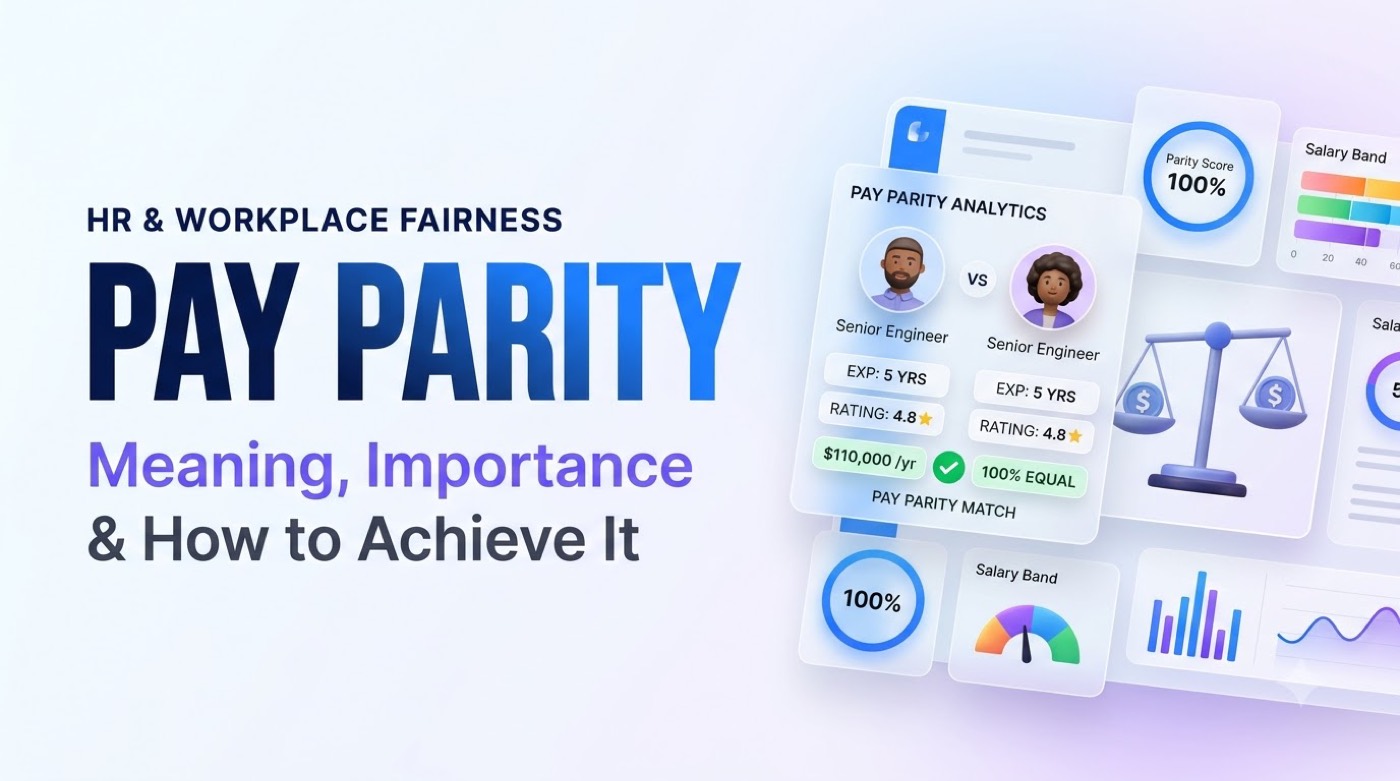
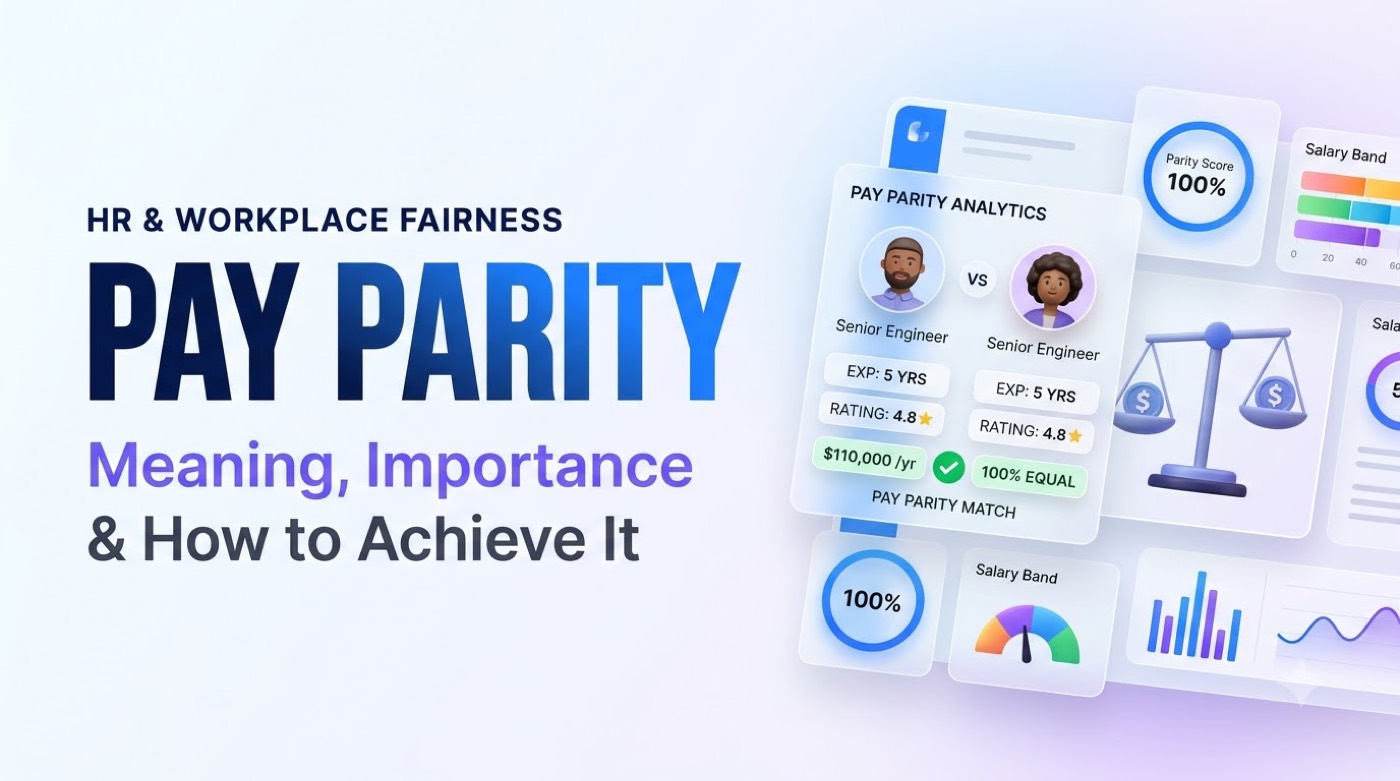
Imagine two employees who perform the same job functions and have similar levels of education, training, and experience. However, one employee earns significantly more than the other without any obvious reason.
Does that sound fair?
This is one of the situations that pay parity aims to address.
Compensation goes beyond the monthly paycheck deposited into an employee’s bank account. It reflects how much value an organization places on its employees, the fairness of its workplace practices, and the importance it gives to its workforce.
In today’s competitive business environment, employees expect transparency in compensation and fair treatment within their organizations. When companies fail to address compensation disparities, they may experience employee dissatisfaction, reduced morale, and increased employee turnover.
This is where pay parity becomes important.
In this article, we’ll explore what pay parity means, why it matters, how it differs from pay equity, what causes unequal pay, and how HR teams can establish fair compensation practices.
What Is Pay Parity?
Pay parity refers to providing equal compensation to employees who perform the same or substantially similar jobs, without discrimination based on gender, race, religion, age, or other personal characteristics.
The goal is to ensure that employees have equal opportunities to earn fair compensation for similar work. Salary and wage decisions should be based on objective criteria such as:
- Job responsibilities and complexity.
- Relevant qualifications and educational background.
- Professional experience and skills.
- Performance and contribution.
- Industry and market salary benchmarks.
- Location and applicable compensation policies.
For example, consider two employees working as software developers in the same company. Both have similar experience, perform the same responsibilities, and deliver comparable results.
If one employee receives a significantly higher salary than the other solely because of gender, it creates a pay parity concern.
However, if the salary difference is justified by legitimate factors such as specialized technical skills, additional responsibilities, or demonstrable differences in job performance, the difference may be reasonable.
The objective of pay parity is not necessarily to provide every employee with exactly the same salary. Instead, it aims to eliminate unjustified compensation differences and establish a consistent, transparent, and fair system for determining employee wages.
Why Is Pay Parity Important in the Workplace?
Fair compensation plays an important role in shaping employees’ relationships with their organizations, workplace culture, and overall business performance.
Employees who believe they are treated fairly are more likely to trust their employers, remain engaged, and contribute positively to organizational objectives.
Here are some important reasons why organizations should prioritize pay parity.
Builds Employee Trust
Employees expect fair recognition and compensation for their contributions.
Organizations that follow consistent compensation practices establish a stronger foundation of trust between employees and management.
Salary transparency can also reduce unnecessary comparisons and uncertainty about how compensation decisions are made.
Improves Employee Retention
When employees receive different salaries for performing similar jobs without a reasonable explanation, they may become dissatisfied and look for other employment opportunities.
Organizations that regularly review compensation practices and address pay inequalities can improve employee satisfaction and reduce employee turnover (attrition).
Strengthens Employer Branding
Organizations recognized for fair compensation practices can develop a stronger reputation in the employment market.
Candidates evaluate companies based on their workplace environment, career development opportunities, employee treatment, and compensation transparency.
A commitment to fair wages can help organizations attract experienced professionals and strengthen their employer brand.
Promotes Diversity and Inclusion
Pay parity supports a workplace environment where employees have equal opportunities to develop their skills and receive appropriate compensation.
Organizations should evaluate whether their hiring, promotion, performance assessment, and salary review processes create disadvantages for particular groups of employees.
Improves Employee Motivation and Productivity
Employees are more likely to remain motivated and focused when they believe their contributions are rewarded fairly.
Fair compensation policies can also improve workplace collaboration, employee engagement, and overall productivity.
Reduces Legal and Reputational Risks
Discriminatory compensation practices can expose employers to potential legal disputes, employee relationship issues, and reputational damage.
Regular salary reviews and properly documented compensation policies help organizations identify and address potential problems.
Pay Parity vs Pay Equity: What Is the Difference?
Pay parity and pay equity are closely related concepts, but they have slightly different meanings.
Both aim to establish fair compensation practices and eliminate discriminatory wage disparities. However, they approach compensation fairness from different perspectives.
Pay parity focuses on ensuring that employees performing the same or similar jobs do not receive unjustifiably different compensation, particularly across demographic groups.
Pay equity takes a broader approach by evaluating whether employees receive fair compensation based on the value of their work, even when their job roles are different.
For example:
- Equal Pay: Employees with identical job titles, similar responsibilities, and comparable experience should receive equal compensation, regardless of gender.
- Pay Equity: An accountant and a financial analyst may have different job titles, but their compensation can be evaluated based on the knowledge, skills, responsibilities, effort, and working conditions required for their respective roles.
Key Differences Between Pay Parity and Pay Equity
| Comparison Factor | Pay Parity | Pay Equity |
|---|---|---|
| Meaning | Providing equal pay for similar work | Providing equitable compensation for work of the same or similar value |
| Main Goal | Eliminating unjustified compensation disparities | Assessing compensation fairness across different roles |
| How It Compares Jobs | Usually compares employees in similar positions | May compare employees in different positions |
| Key Factor | Responsibilities and qualifications of employees in comparable positions | Employees’ skills, efforts, responsibilities, and working conditions |
| Main Objective | Reducing unjust compensation differences | Creating a fair and unbiased compensation system |
Organizations that want to create an equal and fair workplace need to consider both aspects.
What Factors Contribute to Pay Inequality?
Pay disparities are not always intentional. Many organizations develop compensation inequalities over time because of poor hiring practices, outdated salary structures, or the absence of systematic compensation reviews.
Some common factors include:
Gender-Based Salary Differences
One of the most recognized forms of pay inequality is the gender pay gap.
Unequal compensation between male and female employees may occur because of differences in hiring, promotions, salary decisions, and career progression opportunities.
Salary Negotiation Differences
During recruitment, candidates may negotiate salaries differently depending on their confidence, previous earnings, knowledge of the job market, and negotiation skills.
When organizations rely heavily on individual negotiations instead of structured salary ranges, employees performing similar jobs may receive different compensation.
Unstructured Salary Revisions
Without clearly defined salary review policies, compensation adjustments may depend heavily on individual managerial decisions or subjective evaluations.
As a result, employees with similar responsibilities and comparable performance may receive different salary increments.
Limited Promotion Opportunities
When employees or demographic groups have unequal opportunities to advance into leadership positions, compensation disparities can increase over time.
Organizations should regularly evaluate promotion and career development practices to identify potential barriers.
Lack of Compensation Transparency
When employees and managers do not understand how salaries are determined, identifying compensation inconsistencies becomes difficult.
Unclear salary bands, undocumented compensation decisions, and inconsistent appraisal systems can contribute to pay inequality.
How Can HR Teams Achieve Pay Parity?
Achieving pay parity requires more than simply comparing employee salaries.
HR teams need to establish structured processes for managing employee performance, determining compensation, and implementing consistent organizational policies.
Here are some practical steps businesses can follow.
Conduct Regular Pay Audits
Review employee compensation across departments, job functions, experience levels, locations, and demographic groups.
HR professionals conduct pay audits to identify differences in employee compensation, including salaries, bonuses, incentives, and other benefits.
During the audit, examine:
- Employees performing similar responsibilities.
- Salary differences across genders and demographic groups.
- Differences in increments and performance-based rewards.
- Compensation variations across departments and locations.
- Whether salary differences have objective explanations.
The goal is to identify and understand the reasons behind any unexplained compensation disparities.
Establish Clear Salary Bands
Organizations should develop structured salary ranges for different job functions and organizational levels.
For example, a company may establish different salary ranges for junior, mid-level, and senior software developers based on their experience and responsibilities.
Salary bands should consider internal compensation policies, job responsibilities, required experience, and industry benchmarks.
A structured approach reduces arbitrary salary decisions and provides a consistent method for compensation planning.
Standardize Recruitment and Hiring Practices
Pay parity should begin during recruitment rather than after employees have joined the organization.
HR departments should establish consistent methods for evaluating candidate compensation instead of relying entirely on previous earnings or individual negotiation abilities.
Job requirements, relevant experience, skills, and predefined salary ranges should guide recruitment and compensation decisions.
Review Performance Appraisal Processes
Performance appraisals influence employee salary increments, bonuses, and promotion opportunities.
Subjective or inconsistent appraisal procedures can result in unfair compensation differences.
To minimize this risk:
- Define measurable performance indicators.
- Establish consistent appraisal cycles.
- Train managers to recognize unconscious bias.
- Document performance-based salary decisions.
- Review increment patterns across teams.
An objective employee evaluation process helps ensure that compensation decisions are based on employee contributions rather than individual preferences.
Monitor Promotions and Career Progression
When employees do not have equal opportunities for professional growth, salary inequalities may develop.
HR teams should periodically assess promotion rates, leadership representation, and internal employee mobility.
Promotions based on clear criteria and structured career development programs can improve fairness in professional growth opportunities.
Train Managers and HR Professionals
Managers frequently influence recruitment decisions, performance evaluations, promotions, and compensation adjustments.
They should understand the importance of fair pay and how unconscious bias can affect workplace decisions.
Continuous training can help managers make more objective decisions and follow compensation policies consistently.
Review Compensation Policies Regularly
Business requirements, market conditions, and employee expectations change over time.
Organizations should regularly review:
- Employee salary structures.
- Compensation plans and incentives.
- Employee benefits.
- Performance evaluation processes.
- Promotion and increment policies.
Regular reviews help HR teams identify growing pay gaps before they develop into larger organizational issues.
What Role Does HR Play in Maintaining Pay Parity?
HR departments play an important role in establishing and maintaining fair compensation practices.
From recruitment to employee separation, HR teams make several decisions that directly influence employee compensation and professional growth opportunities.
Some key responsibilities include:
- Compensation Planning: Developing salary scales, job levels, grades, and compensation standards.
- Recruitment Management: Evaluating candidates using consistent and objective compensation criteria.
- Performance Management: Establishing fair performance evaluation processes that connect employee contributions with compensation decisions.
- Salary Reviews: Analyzing compensation disparities and recommending corrective actions where necessary.
- Policy Development: Creating clear policies for salary increments, promotions, incentives, and employee benefits.
- Reporting and Monitoring: Identifying compensation trends and potential inequalities across employee groups and departments.
When HR teams have accurate employee and salary information, they can make more informed compensation decisions and maintain greater consistency across the organization.
Pay Parity in the Indian Workplace: What Should Employers Know?
In India, fair compensation is not just an HR best practice; it also has important legal implications.
The Equal Remuneration Act, 1976, was introduced to address equal pay for men and women performing the same or similar work.
Its provisions have since been subsumed under the Code on Wages, 2019.
The Code on Wages includes provisions addressing gender-based wage discrimination for employees performing the same work or work of a similar nature, subject to applicable legal provisions.
Employers should pay particular attention to:
- Non-discriminatory wage and recruitment practices.
- Consistent job evaluation and salary structures.
- Transparent compensation and promotion policies.
- Proper documentation of salary decisions.
- Compliance with applicable labour laws and notifications.
Organizations should distinguish between statutory legal requirements and broader internal pay equity initiatives.
When developing compensation policies, businesses should evaluate their legal obligations and determine how effectively their existing practices meet those requirements.
How Can an HRMS Help Organizations Maintain Pay Parity?
Maintaining fair compensation becomes increasingly challenging as organizations grow.
When employee details, salary records, performance reviews, and payroll information are maintained in separate spreadsheets or disconnected systems, identifying compensation inconsistencies can become difficult.
An integrated Human Resource Management System (HRMS) helps HR departments centralize essential employee and compensation information.
ZestNexus is an HR platform that helps organizations automate various aspects of human resource management, including processes that support better compensation administration.
Here is how an organized HRMS workflow can help:
- Centralized Employee Records: Maintain employee information, employment history, job roles, and department details in one place.
- Employee Compensation Management: Manage salary components, employee benefits, and compensation records consistently.
- Salary Administration: Manage employee salaries and maintain accurate payroll information.
- Performance Management: Maintain employee performance records to support structured appraisal and compensation decisions.
- Payroll Reports: Use employee and payroll reports to identify compensation trends and potential discrepancies.
- Employee Change Tracking: Maintain better visibility into employee modifications, promotions, and salary adjustments.
Technology alone cannot eliminate wage inequality. However, it can help HR departments collect accurate information, establish consistent processes, and make informed compensation decisions.
ZestNexus provides businesses with a unified platform to manage HR, employee information, and payroll operations.
Conclusion
Pay parity is an important part of building a fair, transparent, and inclusive workplace. It aims to ensure that employees performing similar jobs receive fair compensation without discrimination based on gender or other personal characteristics.
For organizations, achieving pay parity requires structured salary systems, regular compensation reviews, objective performance evaluations, and clearly defined HR policies.
Businesses should continuously evaluate their compensation practices, identify unexplained salary differences, and take appropriate corrective action.
By combining structured HR policies with accurate employee and payroll records, organizations can build a workplace culture based on employee appreciation, respect, and fair compensation.
Organize your workplace and improve compensation visibility with ZestNexus. Manage HR activities, handle employee payroll, and make better workforce decisions through one integrated HRMS platform.
Frequently Asked Questions
What is pay parity in simple words?
Pay parity means providing fair and equal compensation to employees performing the same or similar jobs, regardless of gender or other personal characteristics.
What is an example of pay parity?
Suppose two employees work as HR Executives in the same company. They have similar education, experience, and job responsibilities.
If one employee receives a lower salary than the other solely because of their gender, it represents a potential pay parity issue.
What is the difference between pay parity and pay equity?
Pay parity generally evaluates whether employees performing the same or similar jobs receive equal compensation.
Pay equity takes a broader approach by evaluating whether employees performing jobs of comparable value receive fair compensation, even when their job roles are different.
Why is pay parity important for employees?
Pay parity promotes fairness, builds employee trust, reduces workplace discrimination, and helps employees feel that their contributions are valued. It can also improve employee satisfaction and retention.
How can companies measure pay parity?
Companies can evaluate compensation fairness through regular pay audits. These audits compare employee salaries across similar positions and examine variations based on gender, experience, qualifications, job responsibilities, and performance.
Is pay parity legally required in India?
Indian employers must comply with applicable provisions of the Code on Wages, 2019, including provisions addressing gender-based wage discrimination for employees performing the same work or work of a similar nature.
Employers should follow all applicable legal requirements relating to equal remuneration and non-discriminatory employment practices.
Does pay parity mean everyone should receive the same salary?
No. Pay parity does not require every employee to earn the same salary.
Compensation may vary based on experience, qualifications, responsibilities, skills, performance, and location. However, differences should be based on objective and non-discriminatory criteria.
How can HR software help with pay parity?
HR software helps organizations maintain employee records, manage salary structures, process payroll, track performance, and generate HR reports.
These capabilities allow HR teams to review compensation practices and identify potential salary discrepancies.
What is a pay parity audit?
A pay parity audit is a systematic review of employee compensation to identify unexplained salary differences among employees performing the same or similar jobs.
It helps organizations understand the reasons behind compensation inequalities and identify appropriate corrective actions.
Similar blogs you may like